
You found a before-and-after photo that stopped you. A tighter jawline, a smoother neck, a face that looks rested instead of tired. The "after" looks wonderful, but a photo alone never tells you the most important part of the story.
What procedure produced that result? A mini lift and a deep plane facelift can both leave a person looking refreshed, yet they solve very different problems. Without knowing the technique behind a photo, two "afters" that look alike can be far apart. They can differ in what they actually fix and how long they last.
Interest in facial rejuvenation keeps growing, and it is starting younger. If you are weighing your options, you are in good company, and you have time to choose well.
At Prendiville Facial Plastic Surgery in Fort Myers, Florida, Dr. Stephen Prendiville has focused only on the face for 25 years. Below, we walk through five facelift types: mini, SMAS, deep plane, midface and lower, and combined face and neck. For each, we look at what an honest before-and-after really shows.
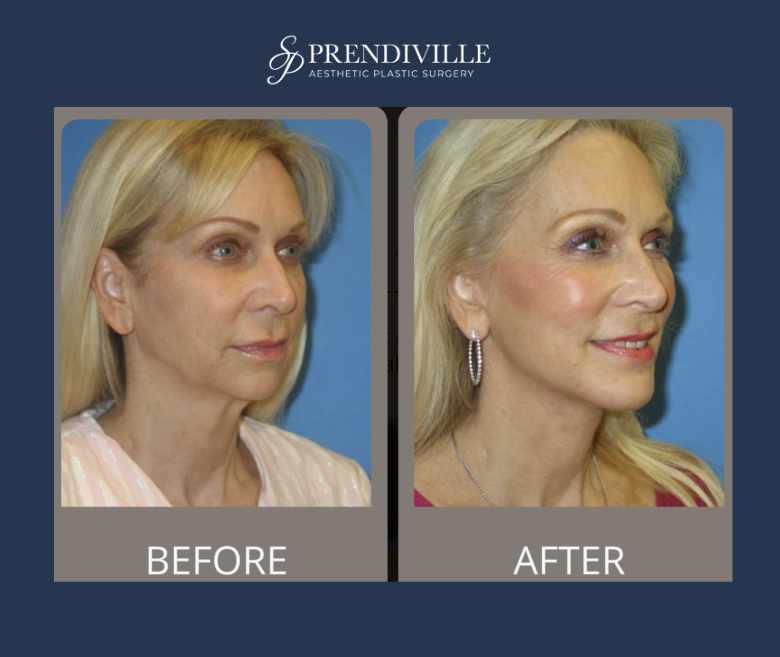
A mini facelift, sometimes called a short-scar lift, focuses on the lower third of the face. It softens early jowls and tidies the jawline through shorter incisions that sit in front of the ear. In a gallery, the "before" usually shows mild sagging, and the "after" shows a cleaner jaw, not a transformed neck.
The honest part matters here. Dr. Prendiville is candid that a smaller, minimal-incision lift only works well when there is little excess skin. As he puts it, when too much loose skin is present, a mini approach simply does not hold. The least happy patient, in his words, is the underdone one, so he matches the procedure to what your face actually needs rather than to the smallest possible scar.
Limited-incision or short-scar facelifts are generally best suited to patients with earlier or more localized lower-face laxity and relatively limited excess skin. Their ability to improve the neck depends on the exact technique and the patient's anatomy. The trade-off is reach: a fuller lift addresses more of the face and neck, and its improvement tends to hold longer.
It is completely normal to want the gentlest option. The most helpful thing is to understand what each procedure can and cannot do, so a single photo does not set your expectations on its own. Here is how the main facelift types compare at a glance, so the galleries ahead make more sense. A facelift does not stop aging, and no procedure has a guaranteed lifespan.
Colleen, a Prendiville Facial Plastic Surgery patient who studied many before-and-after photos before deciding, shared her experience:
"From the original no pressure consultation where everything was thoroughly explained along with many before and after photos of previous patients... he calmly assured me he could achieve the natural results I was looking for, no high-pressure sales. I couldn't be happier!"
If you want to see one practice's gallery and approach for yourself, you can explore the Prendiville Signature Lift and its real patient results whenever you are ready.
To read a facelift gallery well, it helps to know the layer doing the work. The SMAS is the deeper support layer of the face, a sheet of muscle and fibrous tissue tied to the skin above it. A traditional SMAS facelift repositions that layer so the lifting tension sits on the SMAS, not on the skin. That is what keeps the result looking natural instead of pulled.
Dr. Prendiville describes the technique plainly. An SMAS lift raises the skin out toward the smile line and lifts the SMAS as its own layer underneath. It improves the cheeks, the jowls, and early neck laxity, which makes it a strong fit for moderate aging in the 40s and 50s. In before-and-after photos, you tend to see a sharper jawline and a restored angle between the jaw and the neck.
For many people, scarring is the biggest worry here, and that concern is completely understandable. A board-certified facial plastic surgeon hides the incision in the hairline and just along the edge of the tragus, the small piece of cartilage in front of the ear canal. Because the closure places tension on the deeper layer rather than the skin, the scar stays hard to see. The earlobe also keeps its natural shape instead of being tugged downward.
Recovery follows a fairly predictable path. Swelling and bruising peak in the first few days, stitches usually come out around day 7, and most people feel socially ready in about 2 weeks. An SMAS facelift is also durable, with long-lasting results before anyone considers a touch-up. Knowing that timeline makes those polished gallery "afters" easier to trust, because you can picture the weeks that came first.
When aging is more advanced, the deep plane facelift is where natural-looking galleries often come from.
At this practice, that same deep plane work has a name: the Prendiville Signature Lift, the flagship facelift Dr. Prendiville performs himself. He is double board-certified and fellowship-trained, with 25 years focused only on the face. That single-surgeon, face-only focus is what the before-and-after galleries tied to it reflect.
Here is the difference in plain terms. A traditional lift raises the skin and the deeper layer separately. A deep plane lift instead releases the deeper layer along a cheek muscle called the zygomaticus major. It then repositions the deeper tissues, often with work on the neck muscle at the same time. The corner of the mouth, the cheek, the jawline, and the neck are repositioned in a coordinated way, with individualized neck work added when the neck needs it. The result, as he describes it, is a very natural and very complete lift, closed without tension on the skin.
As Dr. Prendiville performs it, a deep plane facelift also includes a deep neck lift. That means removing fat beneath the neck muscle, debulking the anterior belly of the digastric muscles, and debulking the submandibular glands. This is not necessary for every patient, but it is commonly performed, and it greatly improves the neck result.
That is why deep plane "afters" tend to look like a younger version of you rather than a different person. Because the skin redrapes gently over its new foundation, there is no windswept pull and no distorted earlobe. The lift also restores cheek fullness on its own. A well-done deep plane lift is self-volumizing, so separate fat injections often are not needed.
The outcomes back up the popularity. A 2025 review of nearly 2,900 patients found a 94.4 percent satisfaction rate for the deep plane technique. That compares with 87.8 percent for traditional SMAS lifts. Swelling is real and peaks in the first week. Most of it settles within six to eight weeks, and many patients feel photo-ready in two to four.
Louise, a Prendiville Facial Plastic Surgery patient who chose a deep plane facelift, shared her experience:
"I am currently on day 15 of recovery, healing exactly in the timeframe Dr. Prendiville prepared me for. The results so far exceed my expectations, I already look refreshed and natural, and I know things will continue to improve. His focus is ensuring patients still look like themselves, only sooo much better!"
If a deep plane result is what draws you in, the clearest next step is a private consultation, in person or virtually. There, your surgeon reviews your goals and builds a plan for your face. You can start that conversation whenever the time feels right.
Not every face needs a full lift. Sometimes one zone has aged ahead of the rest, and a targeted procedure is the better match. A mid-facelift and a lower facelift each focus on a single region, which is worth knowing when a gallery photo only shows part of the picture.
A midface lift repositions descended cheek tissue and may soften the lid-cheek junction or reduce the appearance of selected tear-trough shadows. It does not correct every cause of under-eye hollowing, and some patients may still benefit from eyelid surgery or volume restoration. This is the same self-volumizing effect seen in deep plane work, where lifting deeper tissue restores fullness. Because the eye area is involved, a mid-facelift is often paired with lower-eyelid surgery.
A lower facelift, by contrast, sharpens a softening jawline. It tightens the deeper support layer and the neck muscle to lift the jowls back into place. As a facial-only specialist, Dr. Prendiville matches the choice to what your face actually shows. Localized aging may be treated with a targeted procedure, while broader laxity across the cheeks, jawline, and neck may require a more comprehensive facelift regardless of age.
A note on the upper face, since it often shares the frame. The preferred move is a small-incision endoscopic brow lift, described as a brow relaxation rather than a dramatic raise. Over-elevated brows are avoided on purpose, because that surprised look is one of the things that reads as obviously "done." Most patients are happy with results well into their 60s and 70s. The goal is always the same. You should still look like yourself, only rested.
If you look at enough galleries, you start to notice how much the neck shapes the result. The face and neck age together as one continuous sheet of tissue. That is why treating only one can leave an odd seam between them. The principle here is simple. Neck contour is usually best addressed as part of a facelift rather than on its own, and a deep plane lift is one of the leading modern facelift techniques for doing it.
The neck result comes from a few coordinated steps. The neck muscle, called the platysma, ages downward and forward and pulls the skin with it. To rebuild a clean jaw-to-neck angle, a surgeon tightens that muscle. This is often a corset-style repair with a deeper sling, sometimes with a little neck liposuction or fat removal beneath the chin. In selected patients that work goes deeper. A deep neck lift also removes fat beneath the platysma and debulks the digastric muscles and the submandibular glands. The payoff is balance. In a 2025 study, nearly 68 percent of facelift patients also needed a neck lift to look natural.
Combining procedures can also bring the upper face and volume into harmony. Eyelid surgery or a brow lift can be added safely, and combining a brow lift with eyelid surgery does not meaningfully raise the risk of major complications. Fat grafting is used only when a face has truly lost volume, since a good deep plane lift usually restores fullness on its own.
Many people worry that doing more means a longer recovery. In practice, combining does not extend the basic two- to three-week timeline, since you heal once instead of several times. Swelling peaks in the first few days, and serious complications stay low. Because every procedure is performed by Dr. Prendiville himself, your plan is coordinated by one surgeon from start to finish.
Rose, a Prendiville Facial Plastic Surgery patient who no longer recognized her neck and jawline in photos, shared her experience:
"friends and family say i look the same as i did 10-15 years ago. when i look in the mirror i see myself, not the person with the heavy neck and jowls that refused pictures. i chose dr prendiville because he is certified in head and neck reconstructive surgery not just plastic surgery. i feel like myself again."
Think back to that one photo that stopped you. The reason it pulled at you was not the surgery. It was the feeling of looking rested, balanced, and like yourself again. Every procedure type in this guide, from a mini lift to the deep plane facelift, is just a different path toward that same feeling, matched to a different face.
When you browse galleries, it helps to look closely at the details. Look for standardized lighting, angles, and poses, and for healing scars that fade over a year rather than vanishing overnight. A result that looks too flawless to be real usually is. The most useful next step is to see real before-and-after photos in person and ask who will actually perform your surgery. You can do that through a private consultation, in person or virtually for out-of-town patients.
When you are ready, Dr. Prendiville and the team in Fort Myers, Southwest Florida, would be glad to talk through what is bothering you and show you what is realistic for your face. You can reach the practice at drprendiville.com or by phone at 239-437-3900. The goal is never a dramatic change. It is a natural, undetectable result that still looks like you.

