The procedure is known medically as a rhytidectomy. It is also one of the most requested facial procedures in the country. The American Society of Plastic Surgeons reported more than 72,000 of them in 2022. Yet most people considering one have never seen what the surgery actually involves.
Knowing the steps takes the mystery out of the day. Dr. Stephen Prendiville has focused only on the face for 25 years. He has performed thousands of facial procedures himself. At Prendiville Facial Plastic Surgery in Fort Myers, FL, every patient gets that same single-surgeon care. This guide covers what a facelift is, the main techniques, what happens in surgery, what recovery looks like, and how the risks stay low.

The word sounds technical, but the idea is simple. A facelift is the surgical term rhytidectomy, which comes from the Greek words for wrinkle and removal. In a facial surgeon's terms, it addresses the cheeks, the jawline, and the neck. The brow and eyelids are separate procedures.
Aging is not only about the skin. It happens in several layers at once. The bones change shape. The deep retaining ligaments stretch. The fat pads slide down and shrink, and the skin loses collagen. Surgical anatomy references describe how these changes create jowls, deeper folds beside the mouth, and loose neck bands. The face in your photos starts to look tired even when you feel well.
A facelift treats those deeper changes. Older surgery simply pulled the skin tight. That created the windblown look people fear, and it did not last. Modern surgery works under the skin instead. It resets the deeper support layer, so the skin can lie back with no tension on it.
It helps to be honest about the limits. A facelift is excellent for sagging and lost structure. It lifts the jawline, softens jowls, and restores the neck. But it does not erase fine surface lines, sun damage, or uneven skin tone. Those concerns live on the surface of the skin. They usually need laser resurfacing, a peel, or good skincare alongside surgery. Knowing this early helps you set expectations you will be happy with.
Not every facelift is the same. The techniques differ mainly in how deep the surgeon works. The right one depends on your anatomy and goals. They share one foundation, a layer called the SMAS. The SMAS is the deeper sheet of muscle and tissue under your skin. Tightening it, rather than just the skin, is what creates a natural, lasting result.
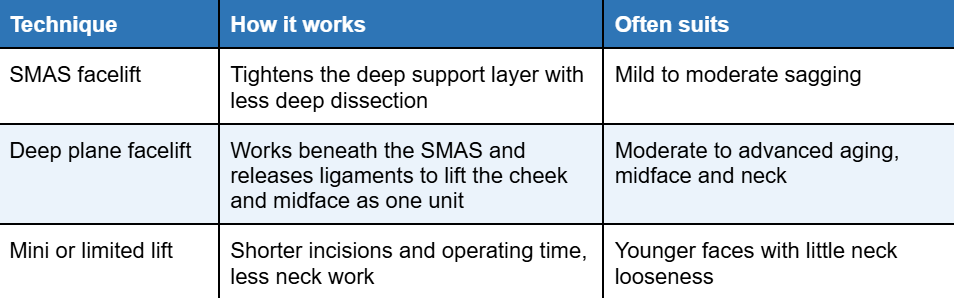
One large review compared the two. It found a 94.4 percent satisfaction rate for the deep plane method, against 87.8 percent for the SMAS approach. Those figures come from a 2025 systematic review and meta-analysis that pooled 21 studies. The tradeoff is that the deeper work carries a slightly higher rate of minor issues.
The deep plane facelift is the heart of the Prendiville Signature Lift™, his approach to natural, long-lasting rejuvenation. He describes it with a simple picture. The SMAS is like a carpet liner, and the skin is the carpet on top. You reset the liner underneath to do the lifting. Then you trim only the small bit of extra carpet, so nothing is closed under tension. The same deep plane lift is one of the leading modern techniques for restoring the neck and jawline, since the neck muscle is tightened along with the deeper face. As Dr. Prendiville performs it, a deep plane facelift also includes a deep neck lift. That can mean removing fat under the platysma muscle, slimming the small digastric muscles below the chin, and reducing the submandibular glands that sit under the jawline. It is not needed for every patient, but it is done often, and it makes a real difference to the neck.
Louise, a Prendiville Facial Plastic Surgery patient who chose a deep plane facelift, shared her experience:
"I recently underwent a deep plane facelift, CO₂ treatment, and lip lift with Dr. Prendiville, and I could not be more thrilled with my experience. From my very first consultation, I felt completely confident and at ease."
The best way to learn which technique fits your face is a private consultation, in person or virtually. You can request one whenever you are ready and talk through what is bothering you.
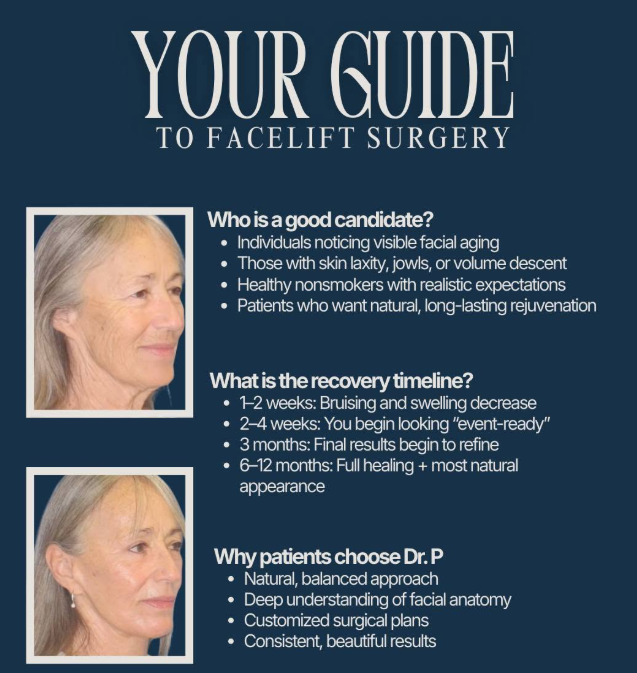
This is the part most people picture least clearly. A facelift is a careful, ordered process. Dr. Prendiville performs every step himself, rather than handing parts to someone else. Here is how a typical surgery unfolds.
It is completely normal to feel nervous about a major procedure. Understanding the sequence often makes the day feel far less daunting.
Deborah, a Prendiville Facial Plastic Surgery patient who felt anxious before her surgery, shared her experience:
"I was nervous about getting such a major surgical procedure, but after meeting Dr. Prendiville and his staff I felt so much more at ease and excited."
Recovery is steady and predictable, and most of it happens sooner than people expect. The first day or two are the most restful, with mild tightness while you wear a soft dressing and keep your head elevated. From there, healing follows a fairly reliable path.
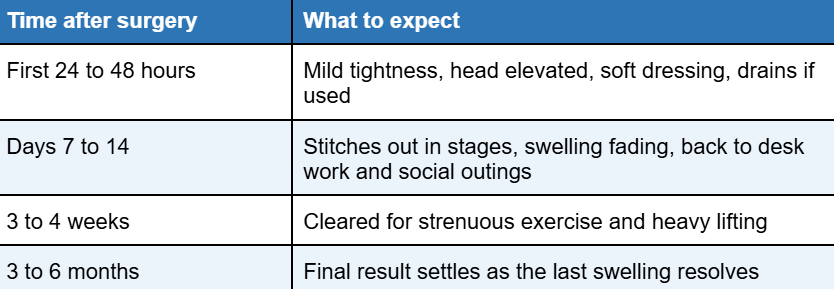
Swelling tends to peak around day three, then eases quickly. The American Society of Plastic Surgeons notes that most patients return to light work within seven to fourteen days. Heavier exercise waits about three to four weeks. Some numbness around the ears and cheeks is normal, and it fades as the nerves recover. Pooled research shows that lasting nerve changes are very rare.
Real patients describe the same arc. In one six-week update after a deep plane facelift, the patient felt back to normal. The jawline was clean and the incisions were already settling. The final result still keeps refining for several months after that.
This is also where concierge care matters. Prendiville Facial Plastic Surgery sees many patients from out of town. The practice offers a dedicated program with recovery support for travelers, along with virtual consultations and private follow-up visits. That means distance does not have to stand in the way.
Ana, a Prendiville Facial Plastic Surgery patient who valued her care through recovery, shared her experience:
"Certified and experienced doctor, expert on face and neck lifts, supported by an excellent staff, who outlines the best procedures for each case without forcing products or services. I had an exceptional experience from the first consultation, and pre and post surgery."
If you are weighing whether you could recover comfortably away from home, a private consultation can walk you through the plan. You can request one, in person or virtually, whenever you are ready.
A facelift is very safe in the right candidate. It helps to see the real numbers rather than guess at them. Most of what you will notice is temporary. Swelling and bruising peak in the first few days and usually clear within two to three weeks. Mild numbness, tightness, and brief muscle weakness can last a little longer as the nerves settle.
Serious problems are uncommon. The most common major one is a hematoma, a pocket of blood under the skin. It happens in only a small share of cases, and when it does, it is usually drained quickly without affecting the final result. Infection and skin healing issues are rarer still. Lasting nerve injury is exceptionally rare: a 2025 meta-analysis of more than 15,000 facelift procedures found permanent nerve damage in well under one percent of cases.
Scarring worries almost everyone, and here there is real reassurance. Facial skin has a rich blood supply and heals well. Placing the incisions with no tension on the skin keeps them discreet. In practice, the scars are rarely something patients raise afterward.
The single biggest safety factor is who performs the surgery. A board-certified facial plastic surgeon in an accredited surgical suite screens candidates and uses proven protocols. Modern safety steps, such as careful blood pressure control, have lowered historical hematoma rates from three or four percent to well under one percent. Dr. Prendiville is double board-certified and has focused on facial surgery alone for 25 years.
You play a part too. Stopping all smoking and nicotine products, including vapes, patches, and gum, protects healing. Follow Dr. Prendiville's instructions on when to stop before surgery and how long to stay off them afterward. Pausing aspirin and certain supplements beforehand lowers the chance of bleeding. Your surgeon will guide you through the full list at your consultation.
Susan, a Prendiville Facial Plastic Surgery patient who researched carefully before choosing her surgeon, shared her experience:
"After many months researching local doctors, I decided on Dr. Prendiville to perform my surgery. I wanted a surgeon who specializes in neck and above, had extensive experience, and was considerate of my particular needs. In January of 2024, Dr. Prendiville performed a deep plane facelift."
That quiet question about what happens on the table has a calm answer. A facelift works by resetting the deeper layers of the face, so the skin can sit naturally. Every step, from anesthesia to closing, is planned to keep you safe and your result subtle.
When you are ready to see whether it suits you, the next step is a private consultation, in person or virtually. You can look through real results on the Signature Lift page and bring your questions to that first talk. There is no rush. The right age for a facelift is really when the changes bother you and you are in good health.
The goal is never to look different or done. It is to look like yourself, only refreshed. To talk through what is on your mind with Dr. Prendiville in Fort Myers, reach out to the practice or call 239-437-3900 when the time feels right.
A mini facelift uses shorter incisions and targets mild sagging in the lower face, with a quicker recovery. A full facelift addresses the cheeks, jawline, and neck together with deeper tissue work. The full approach does more and tends to last longer.
A full surgical facelift is long-lasting, and many patients still look younger than they did years afterward, according to The Aesthetic Society. A facelift does not stop aging, and no procedure has a guaranteed lifespan. Your face keeps aging gently, so results settle naturally over time rather than staying frozen.
You will have incisions, but they are placed in natural creases around the ear and within the hairline, where they fade and become hard to see. Because the deeper layer carries the tension, the skin closes without strain. Most patients find the scars discreet once healed.
The SMAS is the deeper sheet of muscle and connective tissue beneath your skin. Tightening it, instead of just pulling the skin, repositions the underlying structure of the face. That is what produces a natural, lasting lift rather than a tight look.
It can be done either way. Some surgeons use general anesthesia, where you are fully asleep, while others use intravenous sedation with local numbing. The choice is made with your surgeon and anesthesia team based on your health and the plan.
Swelling and bruising usually peak around the third day and improve quickly over the next week or two. Most people feel ready for social outings in about two weeks. Minor residual swelling can take a few months to fully settle.
Many patients return to desk work and gentle activity within seven to fourteen days. Strenuous exercise and heavy lifting should wait about three to four weeks. Your surgeon will clear you based on how you are healing.
A deep plane facelift works beneath the SMAS layer and releases the ligaments that tether the face. This lets the surgeon reposition the cheek and midface as one unit. It is the technique behind the Signature Lift and is known for natural, long-lasting results.
The main risks include a hematoma, which is the most common major complication, along with infection, temporary nerve effects, and healing or scarring concerns. All of these are uncommon when a board-certified facial plastic surgeon performs the surgery in an accredited setting.
Disclaimer: This article is for educational purposes only and is not medical advice. Individual results vary and are not guaranteed. Consult a qualified, board-certified facial plastic surgeon to determine the treatment that is right for you.

