
It helps to be clear about what "lasting" really means. A facelift does not stop aging. It resets your appearance to a younger starting point. From there, your face keeps aging at its normal pace. So the honest answer is not a single number. How long your result lasts depends on three things: the procedure you choose, your own biology, and how you care for your skin afterward.
This article walks through each one. We will compare longevity by facelift type, look at the personal factors that move the number, and cover the habits and treatments that help your result last. At Prendiville Facial Plastic Surgery in Fort Myers, FL, the focus is only the face. Double board-certified facial plastic surgeon Dr. Stephen Prendiville has worked this way for 25 years. His goal is always the same: a natural result that still looks like you. Anatomy, healing, and results vary from person to person, so what is realistic for your face is best decided in a consultation.
One of the biggest factors in how long a facelift lasts is how deep the surgeon works. In Dr. Prendiville's experience, techniques that reposition the deeper support layers of the face hold up better than ones that simply tighten the skin. Your anatomy, healing, and daily habits matter too. Here is how the common options compare.
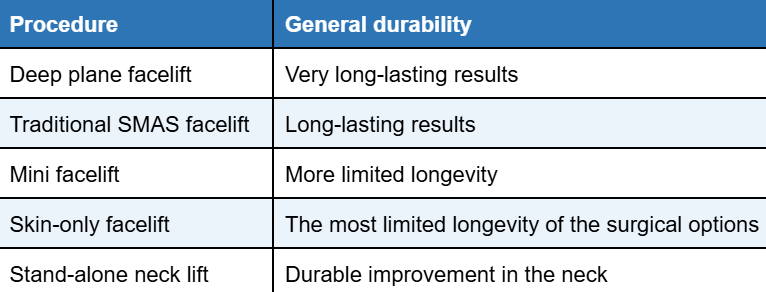
In Dr. Prendiville's view, the deep plane facelift is the most durable of these options. A 30-year study of deep plane patients found they typically went many years before returning for a second procedure. A traditional SMAS facelift lifts the deeper muscle layer, but not as fully. It gives long-lasting results, though generally not as durable as a deep plane lift, according to a longevity study of that technique.
A mini facelift is a lighter, less invasive option. Many people ask how long a mini facelift lasts. The honest answer is more limited longevity than a deeper lift, rather than a set number of years. It resets the clock by a smaller amount, so it tends to suit younger patients with early changes. In his experience, a skin-only lift is the least durable of the surgical options, because it pulls on skin alone and does not reset the deeper layer. A 15-year review of practice-pattern data shows it is now used far less often than the deeper techniques. A stand-alone neck lift is more durable. It holds stable results over the long term in one long-term study.
Depth is why the Prendiville Signature Lift™, Dr. Prendiville's deep plane facelift, is built for the long term. As he explains in one of his videos, a well-performed deep plane lift is self-volumizing. It moves the deeper tissues back up to a higher position instead of stretching the skin over them. That is also why it tends to look natural as it ages, rather than tight. His deep plane facelift also includes a deep neck lift. That can mean removing fat under the platysma muscle, slimming the muscles beneath the chin, and reducing the salivary glands under the jawline. It is not needed for every patient, but it is commonly done and it greatly improves the neck result.
If you are comparing techniques, you can explore the deep plane approach in more depth. When you are ready, schedule a private consultation, in person or virtually, to see which option fits you.
Rose, a Prendiville Facial Plastic Surgery patient who had a lower facelift, shared her experience:
"I had a lower face lift done by dr prendiville and the results are A-MAZING. Friends and family say I look the same as I did 10-15 years ago. When I look in the mirror I see myself, not the person with the heavy neck and jowls that refused pictures."

Two people can have the same procedure and see it last for different lengths of time. That is normal. A lot of it comes down to factors you bring to the table. Knowing them helps you set realistic expectations and protect your result.
Your age at surgery matters more than most people expect. In that same 30-year study, patients who had their first deep plane lift at 53 or younger went noticeably longer before a second one than those who had theirs later. Younger skin has more natural stretch, or elasticity, to work with. That elasticity fades over time as collagen thins.
Daily life leaves its mark too. Ultraviolet light from the sun drives roughly 80 percent of visible facial aging in lighter skin, per a study of photoaging. It breaks down the collagen and elastin that keep results looking fresh. Smoking is harder still on a result. Nicotine narrows the small blood vessels that feed healing skin. One clinical reference reports a much higher rate of skin-healing problems in smokers than in non-smokers. Large swings in weight reshape the face as well, since loss can hollow it and gain can stretch it. If you smoke or use nicotine in any form, raise it with Dr. Prendiville directly. He can tell you how it affects healing in his own patients and what he recommends before surgery.
Genetics fill in the rest. Inherited patterns also shape how quickly your skin ages. You cannot change your genes. But you can control the sun, smoking, and weight. That brings us to the habits that protect your result.
A facelift gives you a strong head start. What you do in the years after surgery decides how much of that head start you keep. The best habits are simple and within your control.
A consistent routine built on a few proven steps does the most:
None of these reverse aging on their own. Together, they slow the changes that shorten a result. The work your surgeon did keeps showing for longer. Some also pair well with in-office treatments, which is where non-surgical options come in.
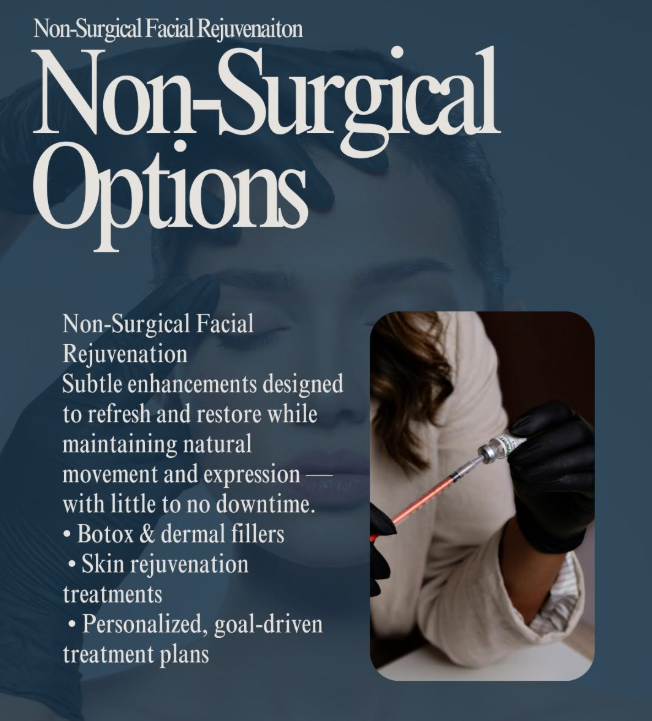
A facelift repositions tissue. But it does not stop the slow loss of volume, or the surface changes that come with age. That is why many patients pair surgery with non-surgical treatments over time. Think of these as upkeep, not replacement. Most can be spaced out across the years.
A few work especially well after a lift:
At Prendiville Facial Plastic Surgery, this full toolkit, from injectables to laser resurfacing, is available to help maintain a surgical result. Dr. Prendiville is also honest about when you do not need it. Because a well-done deep plane lift adds its own volume, he often tells patients that extra filler is unnecessary. He adds it only when a face truly needs it.
Deborah, a Prendiville Facial Plastic Surgery patient who combined surgery with non-surgical treatments, shared her experience:
"I booked a facelift and neck, deep plane CO2 laser face and sculptra injections. Dr Prendiville and his staff guided me step by step through pre-op and post-op procedures. It's been 4 months and I am so so happy with my results."
If you would like to map out the right plan for your face, you can request a private consultation, in person or virtually, whenever you are ready.
It helps to see how a result unfolds over time, from the first weeks of healing to years down the road. The timeline below gives you a realistic picture.
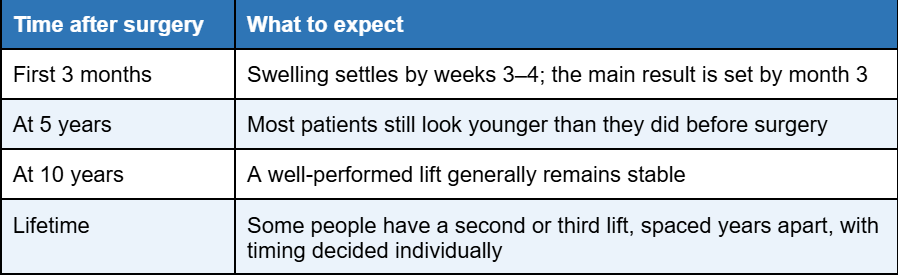
In the early weeks, swelling and bruising peak around days three and four. Most of it fades by weeks three to four. The deeper result keeps settling. By about three months, it has largely taken shape. Five years out, the picture is reassuring. An objective study found that 76 percent of patients still looked younger than before surgery, with the jawline holding especially well.
Over a lifetime, some people who choose surgery go on to have a second or third facelift. Second lifts are commonly performed, and your surgeon will weigh your health, anatomy, and healing before recommending one. The gap between a first and second is measured in years rather than a set number, based on the long-term data. When and whether to do that is a personal call. It is one Dr. Prendiville weighs with each patient. His view on timing is simple. The right age is when the changes that bother you are actually there, and you are healthy enough to address them. He also notes that treating several concerns together, the face and the eyes for example, often looks more natural than doing one small thing at a time.
Louise, a Prendiville Facial Plastic Surgery patient who is a year past her deep plane facelift, shared her experience:
"I look the very same as fifteen to twenty years ago. A year later, I'm simply very grateful that I look exactly like my younger self. I would not hesitate to return to him for any future enhancements."
That morning in the mirror is what brings most people to this question. You want a clear, honest answer, not a sales pitch. A facelift can give you many years of looking refreshed and like yourself. How many depends on the technique, your biology, and the care you give your skin. A deep plane lift offers the longest hold in his experience, and good habits stretch any result further.
When you are ready to learn what is realistic for your own face, the best next step is a conversation. A consultation lets you talk through what bothers you, see real before-and-after results, and leave with a plan built around your goals. It is also the right place to ask Dr. Prendiville directly about his techniques, your own concerns about risks and complications, and his experience with the procedure.
That plan comes from one surgeon who does the work himself. Dr. Prendiville and the team in Fort Myers focus only on the face. The aim is one thing: a natural, lasting result that still looks like you. To start a private consultation, in person or virtually, reach the practice at 239-437-3900 or through the contact page.
No. A facelift resets your appearance to a younger starting point, but your face keeps aging naturally from there. That is why results are best described as long-lasting rather than permanent. Good skin care afterward helps you hold the result longer.
Most people have their first facelift somewhere from their mid-50s into their early 60s. Many start noticing changes in their late 40s. The right time is less about a number and more about whether the changes that bother you are present, and whether you are healthy enough to address them.
Yes. Second facelifts are commonly performed. They are usually done many years after the first, once the changes that bother you have returned. Many people plan for one over the course of a lifetime, and your surgeon can advise when the timing makes sense for you.
A mini facelift addresses less and gives more limited longevity. A full facelift repositions more of the deeper tissue and gives long-lasting results, and a deep plane technique gives the longest-lasting improvement. The difference comes down to how much of the deeper tissue the procedure repositions.
It should not when the technique is done well. Modern facelifts lift tissue along natural, mostly vertical lines rather than pulling it tight toward the ears. The goal is a refreshed, age-appropriate result that still looks like you, not a tightened or operated look. The best way to judge this for yourself is to sit down with Dr. Prendiville, look at his own before-and-after results, and hear how he would approach your face.
Facelift incisions are placed in natural creases around the ear and into the hairline. Every surgery leaves a permanent scar, and healing varies from person to person. Careful placement and closure give a scar the best chance to mature and fade. Dr. Prendiville can show you where your incisions would sit and what to expect from them.
Yes. A deep plane facelift works beneath the muscle layer and releases the ligaments that hold the face down. That is more involved than a traditional SMAS lift. The deeper release is also what gives it a natural look and longer-lasting hold.
As a general range, light to moderate activity often resumes around 3 to 4 weeks and high-intensity workouts around 4 to 6 weeks. Timing varies with the extent of surgery, whether procedures were combined, your health, and how you heal. Dr. Prendiville gives each patient their own schedule, so follow his guidance rather than a general range.
No. A facelift repositions sagging tissue, but it does not treat the skin's surface. Fine lines, sun damage, and discoloration are better handled with laser resurfacing, peels, or a good skincare routine. That is why the two are often combined.
Disclaimer: This article is for educational purposes only and is not medical advice. Individual results vary and are not guaranteed. Consult a qualified, board-certified facial plastic surgeon to determine the treatment that is right for you.

