The choice that matters most is not the city, the price, or even the technique. It is the surgeon. The nose sits at the center of the face, so a poor result is hard to hide and harder to fix. Published revision rates vary widely, because studies differ in the patients they included, how complex the surgeries were, how long patients were followed and what they count as a revision. One clinical review of the research puts the rate after a first rhinoplasty as high as about 15 percent.
This guide is written from the view of a facial-only practice. At Prendiville Facial Plastic Surgery in Fort Myers, Florida, Dr. Stephen Prendiville has focused only on the face for 25 years. He performs every procedure himself. What follows is what a specialist looks for. You will learn how to read a surgeon's credentials and judge their results. You will see how to weigh popular destinations in an honest way. And you will learn what to ask in a consultation, and how to plan when the right surgeon is not in your city.
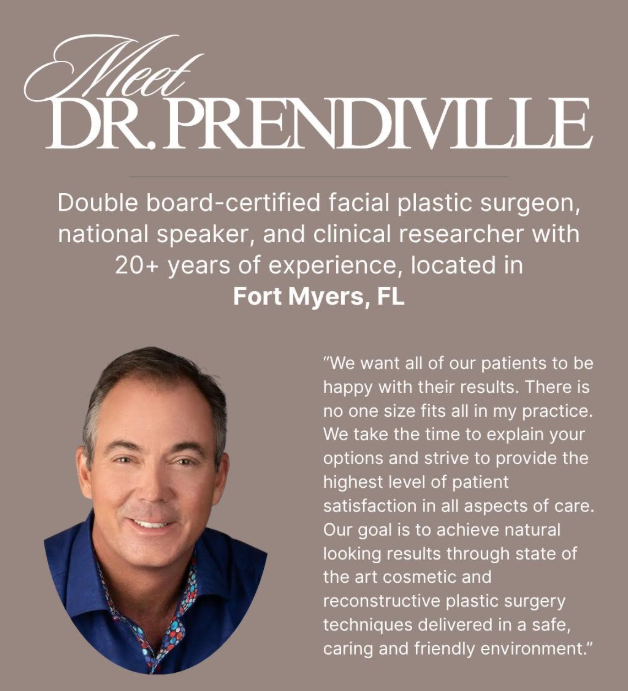
Start with board certification. It tells you the surgeon met a strict, independent standard. Two paths lead to the nose, and the difference is worth knowing.
A general plastic surgeon trains to operate across the whole body. That path is certified by the American Board of Plastic Surgery, the only plastic surgery board recognized by the American Board of Medical Specialties. A facial plastic surgeon usually trains first in otolaryngology, which is head and neck surgery. They then complete a fellowship focused on the face. Facial plastic surgeons are certified by the ABFPRS, the American Board of Facial Plastic and Reconstructive Surgery. Neither route is "better" for everything. But for a nose, you want a surgeon whose training and daily work center on the face.
A fellowship adds focused training after residency, aimed right at facial surgery. It is the difference between a surgeon who does noses now and then and one who has spent years refining the work. A 2019 analysis of 40 rhinoplasty malpractice cases that reached a jury verdict or settlement found that none of the cases ending in an award to the patient involved a fellowship-trained surgeon. It is one small study of lawsuits, not a measure of surgical results.
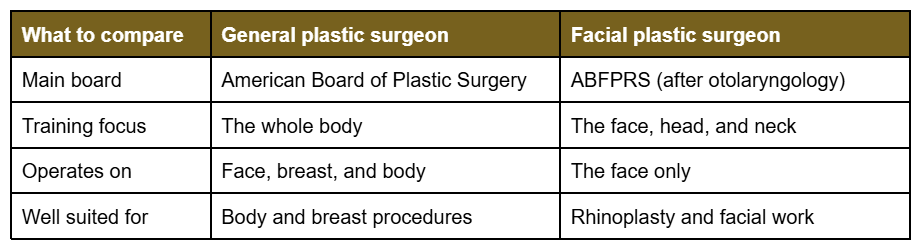
Dr. Prendiville is a good example of the standard to look for. He is double board-certified, in facial plastic and reconstructive surgery and in otolaryngology, head and neck surgery. He completed his fellowship under Dr. J. Regan Thomas, a recognized leader in the field. He has also published and spoken on rhinoplasty at national meetings. You do not need your surgeon to match that resume exactly. You do want the same shape of credentials.
You do not have to take a website's word for any of this. Your surgeon should hold active admitting privileges at a local hospital. That means a hospital has checked their credentials, and an emergency path exists. Membership in a group like the AAFPRS or the Rhinoplasty Society is another good sign. Best of all, you can look up any surgeon's license and disciplinary history through your state medical board. It takes a few minutes, and it is worth doing before you book.
Credentials get a surgeon in the door. What they have actually built with those credentials is the next thing to study.
Certification tells you a surgeon is qualified. Their experience and their photos tell you if they are right for your nose. Two things matter most here. One is how often they do the procedure. The other is what their results actually look like.
Volume and focus go together. The surgeons who do this best will tell you to compare apples to apples. If you are only one of 10 or 15 of a procedure a surgeon does in a year, you are probably in the wrong chair. A dedicated facial specialist performs rhinoplasty far more often, and that practice shows in the result. So ask, simply, how many rhinoplasties they do, and how much of their work is on the face.
Then learn to read before-and-after photos the way a pro would. Look for clear images taken at the same angle, lighting, and distance, against a plain background. Be wary of shadows, heavy makeup, or a shifted camera angle that can flatter a result. Most of all, look for outcomes that appear natural for that patient. Look for noses that started out like yours. The standard to hold is simple. When a rhinoplasty is done well, the nose should belong to your face, not stand out from it.
Megan, a Prendiville Facial Plastic Surgery patient who wanted a natural result from rhinoplasty, shared this experience:
"I had a rhinoplasty with Dr. Prendiville in April 2024, and had a wonderful experience. My recovery wasn't painful at all. The hardest part was waiting two weeks to get the cast and tape off, to see the results. And the results are better than I could've imagined. I look like a refined version of myself. I'm so happy."
If you have a picture in your mind of the result you want, ask whether the surgeon uses 3D imaging. Many surgeons can now show you a simulated preview of your nose, which helps make sure you and your surgeon are picturing the same thing. When you feel confident you have found real skill, it is a good moment to request a private consultation, in person or virtually, to talk through what is realistic for your nose.
It helps to be honest about the landscape, since you have already seen it in your search results. A handful of places have become well-known for nose surgery. Istanbul, Seoul, and Thailand draw patients from around the world, often with lower prices and all-inclusive packages. In the United States, cities like New York, Los Angeles, and Orange County are known for high-end work. This is not a ranking. No honest guide would send you to a clinic abroad you have never seen.
The real question is not which city is trendiest. It is what happens after surgery. Traveling far for a lower price can save money upfront. But it can cost you where it matters most, which is continuity of care. If a problem comes up, you may have little recourse in a foreign country. And a surgeon at home may not want to manage someone else's complication.
Dr. Prendiville has spoken about this directly. People often travel to places like Turkey mainly because the price is lower. There are skilled surgeons there, but complications can happen. And you are left with less recourse abroad. The training, and especially the follow-up after surgery, are generally higher in the United States. Rhinoplasty is not just a cosmetic procedure. It is a precise, functional surgery that depends on careful planning and steady care.
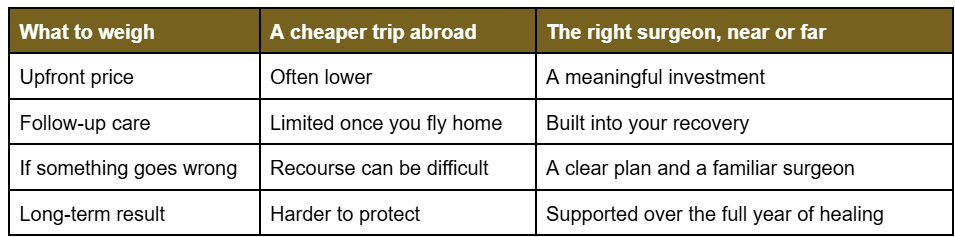
If you do think about traveling, hold any destination to real standards. The facility should carry recognized accreditation, such as Joint Commission International for hospitals abroad. The surgeon should be properly credentialed. And you should have a clear plan for follow-up before you go. The safest destination, in the end, is a surgeon you trust. You often do not have to travel far to find one. Many patients travel across the country for exactly that reason. Before you book a trip anywhere, ask Dr. Prendiville what could go wrong after rhinoplasty and how he would handle it if it did.
A consultation is a two-way conversation, not a sales meeting. It is your best chance to see how a surgeon thinks. Go in with a short list of questions, and pay as much attention to how they answer as to what they say.
Here are the questions worth asking:
Just as important are the warning signs. Dr. Prendiville names three red flags to watch for. A surgeon who cannot clearly explain the risks, recovery, and realistic expectations is a red flag. A rushed consultation is a red flag. And a provider who sells you procedures before they understand your goals is a real red flag. His rule of thumb is simple. A good provider educates first and treats second.
This is where single-surgeon care becomes reassuring. He performs every procedure himself, and follows rhinoplasty patients for a full year, because the nose keeps refining as it heals. A consultation with him starts with a full facial analysis. It is your chance to speak directly with him about how he would approach your nose, the risks that worry you, and his own revision and complication history with rhinoplasty. It ends with a plan built around your goals and your safety.
Colleen, a Prendiville Facial Plastic Surgery patient who valued an unhurried, no-pressure consultation, shared this experience:
"From the original no-pressure consultation with Dr. Prendiville, everything was thoroughly explained along with many before-and-after photos of previous patients. He listened to my concerns and very calmly explained the procedures he would recommend to get the results I wanted. I left the office feeling confident. No high-pressure sales."
Sometimes the surgeon who checks every box is not in your city. If that happens to you, it helps to know how a practice supports out-of-town patients before you rule anyone out.
Distance does not have to mean compromise. It does mean planning carefully, so your safety and your result are never left to chance. Start with the facility, because that is where safety is won or lost.
Wherever you go, confirm the surgical facility is accredited by a major body. Good examples are QUAD A, the Accreditation Association for Ambulatory Health Care, or The Joint Commission. These groups check safety, staffing, and emergency standards. Be wary of unusually cheap, all-inclusive packages. They often cut corners on the very things that keep you safe. A 2022 systematic review found that patients returning from medical tourism had high rates of infection and hospitalization. A low price can become an expensive problem.
Then build a real plan for the days around surgery. For rhinoplasty, follow your surgeon's guidance on when it is safe to travel. Give yourself time to stay reachable for that first, important follow-up. Arrange local care and an emergency plan at home before you leave, so help is never far away. And budget for the true total cost, not just the surgeon's fee.
A complete budget usually includes:
This is where a thoughtful out-of-town program makes a real difference. The practice offers a private virtual consultation with Dr. Prendiville himself. On that call you can talk with him about your goals and about recovering away from home before you ever board a plane. From there, a patient concierge helps coordinate travel, timing, and recovery. The same year-long follow-up applies. As the team puts it, excellence has no zip code. Your own cost is reviewed privately at your consultation, never guessed from a package price online.
Think back to all those options you were weighing across cities and countries. The way out is not to find the flashiest gallery or the lowest price. It is to choose the right pair of hands. Let credentials, real experience, honest results, and steady care guide you there. The best rhinoplasty surgeon is defined by those things, not by a city on a map.
When you are ready for the next step, you can look at the rhinoplasty results at his Fort Myers practice. See whether they reflect the natural, still-you outcome you are hoping for. There is no rush and no pressure. This is your decision to make on your own timeline.
Dr. Prendiville and his team in Fort Myers would be glad to help you understand what is possible for your nose. The goal that guides all of his work is a simple one, a refreshed and natural result that still looks like you. You can request a private consultation, in person or virtually. You can also call the practice at 239-437-3900. Thank you for reading, and take good care.
It means the surgeon holds certification from two separate boards. For a facial plastic surgeon, the two are usually otolaryngology–head and neck surgery and facial plastic and reconstructive surgery, each certified by its own American board. Dr. Prendiville holds both.
There is no single normal rate. Published figures vary widely with the patients studied, the complexity of the surgery, the length of follow-up and how each study defines a revision. One review of the clinical literature puts the rate after a first rhinoplasty at up to about 15 percent. Speak directly with Dr. Prendiville about his own revision history with rhinoplasty and what he counts as a revision, so you are weighing real numbers rather than a published range.
In an open rhinoplasty, the surgeon makes a small incision on the strip of skin between the nostrils for a full view of the structure. In a closed rhinoplasty, all incisions are placed inside the nostrils. Any incision leaves a permanent scar, and how it finally looks varies from person to person. Which approach fits depends on your anatomy and goals, so ask Dr. Prendiville directly which one he would use for your nose and why.
A primary rhinoplasty is the first surgery on a nose that has not been operated on before. A revision rhinoplasty corrects or improves a nose after an earlier surgery. Revisions are usually more complex, which is one more reason to choose carefully the first time.
Yes. Thicker skin can soften fine tip refinements and make swelling take longer to settle. A skilled surgeon adjusts both the technique and the expectations they set. If your skin is thick, Dr. Prendiville can tell you at consultation how he would plan around it and how much refinement your skin is likely to show.
The biggest risks are practical ones. You may face language and communication barriers, limited access to your operating surgeon for follow-up, and difficult recourse if a complication occurs. These are the reasons continuity of care should weigh heavily in any decision to travel. Before you commit to a clinic abroad, it is worth asking Dr. Prendiville how he would follow you through recovery and what his own complication record with rhinoplasty looks like.
They can be, but only if the surgery is performed in a licensed, internationally accredited facility by a properly credentialed surgeon. An unusually cheap package is a warning sign, not a bargain. Always confirm the facility and the surgeon before the price. If a package is tempting, bring it to a consultation and let Dr. Prendiville walk you through the safeguards he would want in place and the risks that concern you most.
Usually not right away, and no single waiting period fits everyone. When it is safe to fly depends on how your recovery is going and whether any complication has come up. Travel should be approved by your surgeon based on your recovery, so plan the trip home around that clearance rather than a set number of days.
Disclaimer: This article is for educational purposes only and is not medical advice. Individual results vary and are not guaranteed. Consult a qualified, board-certified facial plastic surgeon to determine the treatment that is right for you.

