You catch your reflection in a window, and your eye goes to the same place. The jawline that used to look crisp now softens into jowls. The neck that once held a clean line now sags or gathers fullness under the chin. Your face may still feel like you, but the lower third tells a different story.
It is completely normal to notice these changes and not feel ready for them. Most people who look into a lower face and neck lift say the same thing. Their skin still looks good, but the jawline and neck have aged ahead of the rest. A survey from the American Society for Dermatologic Surgery found that 73 percent of people were most bothered by excess fat and loose skin around the chin and neck.
This is one of the most common concerns patients bring to Prendiville Facial Plastic Surgery in Fort Myers, Florida. Dr. Stephen Prendiville is a double board-certified facial plastic surgeon with 25 years focused only on the face, and he performs every procedure himself. This guide covers how the lower face and neck age and how a lower facelift differs from a neck lift. It also walks through the techniques used, what recovery looks like, what shapes the cost, and who is a good candidate.
The lower face and neck look like two areas, but under the skin they are one structure. A support layer in the face called the SMAS, the deeper sheet that holds tissue in place, flows down over the jaw and becomes the platysma muscle of the neck. Because that sheet is continuous, what happens in one area pulls on the other.
In the lower face, jowls form when the small ligaments that hold cheek fat in place weaken and stretch. Anatomical reviews explain how cheek fat then slides down and spills over the jawline. That is what blurs the once-crisp border between the face and the neck.
The neck ages in its own way. Vertical bands appear when the edges of the platysma muscle separate. Loose skin and fat gather under the chin, which softens the sharp angle between the chin and neck. Skin also loses firmness as collagen fades, and that tends to speed up after about age 50.
There is a simple reason the two areas move together. The platysma starts in the lower face and runs down into the chest, and as it ages it pulls the skin downward with it. The neck rarely sags on its own. It usually moves with the lower face, which is why the two are best treated as one.
The easiest way to tell these apart is to use the jawline as the dividing line. A lower facelift works above it. A neck lift works below it. They share a goal but treat different zones, and knowing which one fits your concern is the first real step.
A lower facelift targets the bottom third of the face. It lifts the jowls, sharpens the jawline, and softens the lines beside the mouth. A neck lift, sometimes called a platysmaplasty, works under the jaw. It tightens the neck bands, refines fullness under the chin, and smooths loose skin to restore a more youthful chin-to-neck angle, which sits ideally near 90 to 105 degrees per surgical references.
Here is a quick way to compare the options.
One point surprises many patients. A neck lift alone rarely improves significant jowls, which sit above the jawline and generally need the lifting direction of a facelift to correct. When both the jowls and the neck have aged, combining the two is one of the leading modern approaches, and it is common because the platysma runs continuously from the face into the neck. In fact, lifting the deeper face layer is often the most reliable way to restore the jawline, and pairing it with individualized neck-lift techniques addresses the neckline in a coordinated manner.
Reshaping the lower face and neck comes down to working with the deeper layers, not just the skin. The foundation is repositioning the SMAS, that deep support sheet. Lifting it upward and slightly outward is what rebuilds a clean jawline. A 2025 analysis found that SMAS-based facelifts carry a high satisfaction rate of about 88 percent.
For more advanced sagging, the deep plane technique goes further. It lifts the skin and the deeper layer together and releases the ligaments that anchor the tissue down. This lets the surgeon move the fallen tissue without pulling on the skin. A 2025 systematic review reported a satisfaction rate above 94 percent for deep plane facelifts.
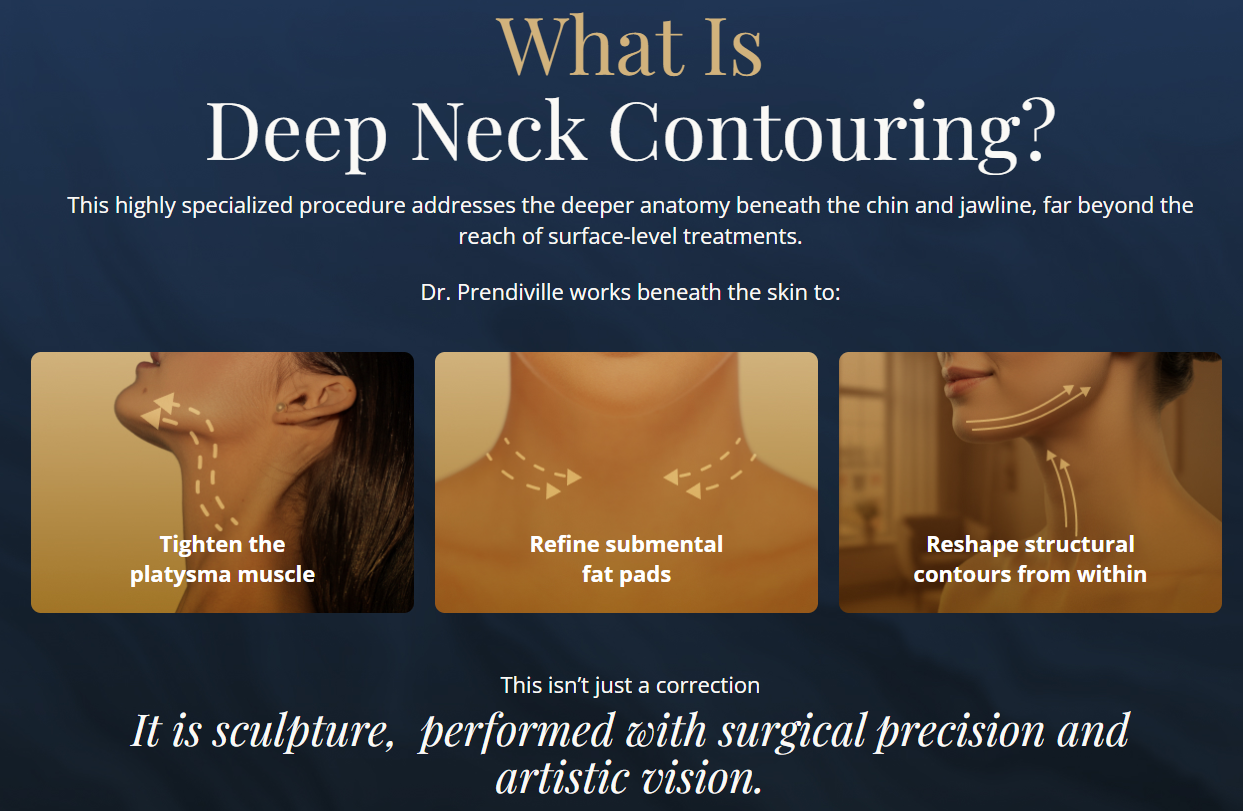
Dr. Prendiville's own version of this is the Prendiville Signature Lift, his deep plane facelift. It works in that same deeper layer, lifting and repositioning the support tissue rather than just tightening the skin. As he performs it, a deep plane facelift also includes a deep neck lift. That involves removing subplatysmal fat, debulking the anterior belly of the digastric muscles, and debulking the submandibular glands. It is not necessary for every patient, but it is commonly performed and greatly enhances the neck results. He plans each one around your own anatomy instead of a set routine, which is what keeps the result looking natural.
He describes the difference simply. A skin-only lift pulls on the skin. A deep plane lift moves the deeper layer and lets the skin settle without tension, as he shows in his explanation of a SMAS versus a deep plane facelift. You lift the support layer underneath, then trim the extra skin and close it without any pull.
Under the jaw, the neck is reshaped with its own steps. A corset platysmaplasty stitches the neck muscle back together down the middle. Liposuction under the chin removes the small fat pad that blurs the chin-neck angle. These steps can sharpen that angle noticeably. A posterior sling can also support the neck from behind.
Scars worry almost everyone, and that is fair. Incisions are tucked just inside the edge of the ear, with the tension kept on the deeper layer rather than the skin. That helps them heal as nearly invisible lines and avoids a pulled earlobe. Facial skin also heals well because it has a rich blood supply.
Louise, a Prendiville Facial Plastic Surgery patient who chose a deep plane facelift, shared her experience:
"I recently underwent a deep plane facelift, CO₂ treatment, and lip lift with Dr. Prendiville, and I could not be more thrilled with my experience. From my very first consultation, I felt completely confident and at ease."
If you want to understand which technique fits your face, you can request a private consultation, in person or virtually.
Recovery sounds like the scariest part, but it tends to be more manageable than people expect. Dr. Prendiville describes very little pain after a deep plane facelift. He frames healing in two parts. There is physical recovery, when swelling and bruising fade, and what he calls feeling like yourself again, when you are happy with how you look.
The first few days bring the most swelling and a feeling of tightness, which is normal. Sleeping with your head elevated helps it settle. Any small drains, if used, come out within a day or two.
By about one week, the sutures begin to come out. At roughly two weeks, most patients are seen in the office and cleared for makeup, and light walking is fine. Bending over and exercise are paused for the first two weeks, then light cardio can resume. Heavier workouts and weight training wait until about four weeks.
The deeper contours keep refining for months. Healing is treated as a roughly year-long process, with follow-up for a full year, because the final jawline and neckline take time to settle. The reassuring part is that most of the visible recovery is behind patients within two weeks.
Deborah, a Prendiville Facial Plastic Surgery patient who had a combined facelift and neck procedure, shared her experience:
"I was nervous about getting such a major surgical procedure but after meeting Dr Prendiville and his staff I felt so much more at ease and excited. I booked a facelift and neck, deep plane, CO2 laser face and sculptra injections."
There is no single price for a lower face and neck lift, and that is honest, not evasive. The investment depends on what your face actually needs, and that can only be mapped out in person. Still, it helps to know what shapes it.
The biggest factors are the scope and the technique. Treating the lower face alone differs from combining it with full neck work. A straightforward lift takes less time than a deep plane lift paired with neck muscle tightening and fat refinement. More involved surgery means more operating time and anesthesia, which factor in along with the surgical facility.
Combining the lower face and neck in one session broadens the surgery, but it means one anesthesia and one recovery instead of two. Combined procedures do carry a slightly higher, though still low, complication rate than a facelift alone, per a database study of 11,300 facelifts. That is one reason careful planning and an experienced surgeon matter.
This is why an in-person evaluation comes first. Every patient has a different mix of skin laxity, fat under the chin, muscle banding, and jaw structure, so a plan needs a hands-on exam. The neck is delicate terrain that deserves real expertise rather than the lowest fee. If travel is part of your picture, you can explore the practice's out-of-town and virtual options when you are ready.
The best candidates share a simple combination. They have real aging changes to address, and they are in good health for surgery. As Dr. Prendiville puts it, you should be in good health and actually want to do something about changes that are present.
On the physical side, good candidates tend to have visible jowling, a soft jawline, loose neck skin, or neck bands. Surgical references describe these as the signs that respond well to a combined lift. If your aging is mild, you may not need surgery yet.
Health and lifestyle matter for safety. All smoking and nicotine products must be discontinued according to the surgeon's preoperative and postoperative instructions because nicotine significantly impairs circulation and healing. Well-controlled blood pressure lowers the small risk of bruising under the skin, as noted in research on facelift risk factors. Your surgeon reviews these details with you to keep surgery safe, not to alarm you.
Age is less of a rule than people think. He performs facelifts for patients in their 50s, most often in their 60s, and into the 70s and beyond. The ideal age is really when you are ready and the changes are there. For milder concerns, non-surgical options like injectables or laser treatments can help, working alongside surgery rather than replacing it.
Ana, a Prendiville Facial Plastic Surgery patient who valued a no-pressure assessment, shared her experience:
"Certified and experienced Doctor, expert on face and neck lifts, supported by an excellent staff, outlines the best procedures for each case without forcing products or services. I had an exceptional experience from the first consultation, pre and post surgery."
If you started reading because your jawline or neck no longer matches how young you feel, you now have a clearer picture of why that happens and what can be done. The lower face and neck age together, a lower facelift and a neck lift treat different zones, and combining them often gives the most balanced result.
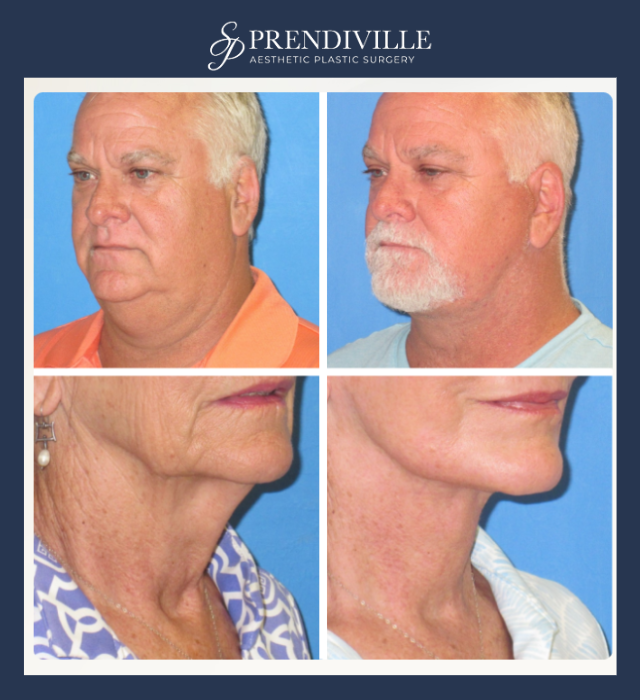
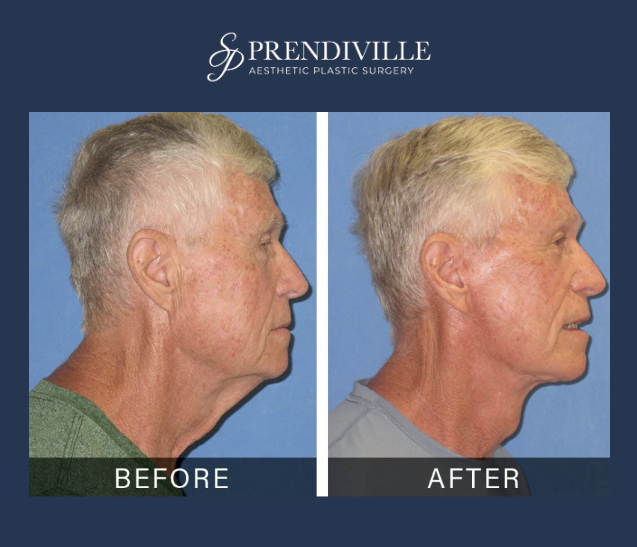
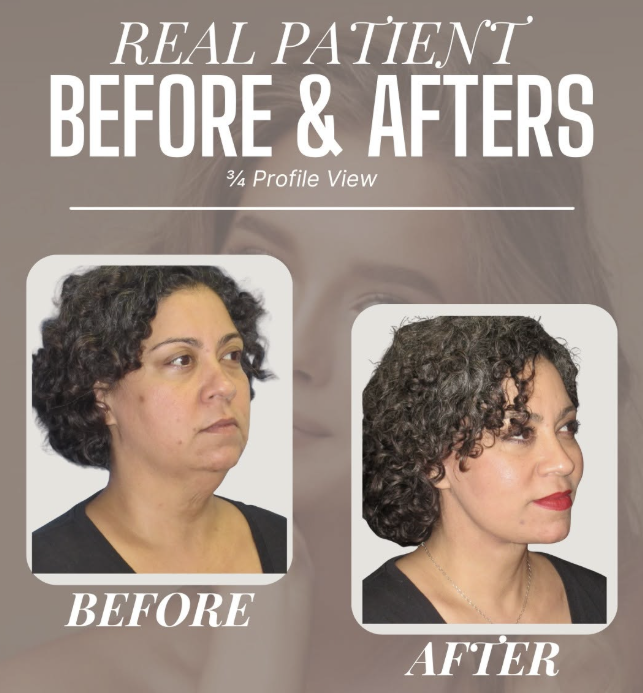
When you are ready to see what is possible, the most useful next step is a private consultation, in person or virtually. You can look through real before-and-after results from the Signature Lift, talk through what is bothering you, and leave with a plan built for your face.
Choosing the right surgeon matters most, and a good one shows you their own patients' results. With 25 years focused only on the face, Dr. Prendiville performs every procedure himself, with one goal in mind: a natural, refreshed result that still looks like you. To learn more, reach out to Prendiville Facial Plastic Surgery in Fort Myers through the contact page or call 239-437-3900.

