There is good reason for that whole-face view. A study of rhinoplasty patients suggests that some may also benefit from chin augmentation to improve facial proportions, and a comprehensive facial analysis helps determine whether addressing both would create a more balanced profile. To know whether that applies to your face, speak directly with Dr. Prendiville about how he assesses facial balance, any concerns you have about adding a procedure, and his experience and complication history with chin augmentation.
At Prendiville Facial Plastic Surgery in Fort Myers, FL, double board-certified facial plastic surgeon Dr. Stephen Prendiville has focused only on the face for 25 years. He performs every procedure himself. This article covers the four things patients ask about most. Those are combining a nose with a chin implant, pairing a nose with a lip lift, what makes ethnic rhinoplasty different, and why revision surgery is its own kind of demanding.
Think of your profile as a set of proportions rather than separate parts. A strong nose can make a modest chin look weaker than it is. A modest chin can make the nose look larger than it is. Balancing the two together often gives a softer, more harmonious result than working on the nose by itself.
Surgeons do not eyeball this. They use set profile lines, such as the Frankfort horizontal line and the Legan angle, to measure where the chin sits relative to the nose and lips. A clinical reference describes how these measurements guide implant planning. Surgeons evaluate facial proportions, chin projection, jawline structure, and overall profile balance to decide whether chin augmentation is appropriate and which implant dimensions may give a natural result. Dr. Prendiville's rhinoplasty consultation begins with a full facial analysis for this reason, so the plan fits your face and not a template.
He is also candid that more is not always better. As he puts it about adding chin projection, "I only suggest it when I think it's really going to provide some benefit." That honesty matters, because the goal is balance, not extra surgery.
When a chin implant and a rhinoplasty make sense together, combining them into one operation means a single anesthesia, and it may allow you to recover from both procedures during the same period. However, swelling, discomfort, and recovery needs may increase depending on the extent of surgery.
Any incision leaves a permanent scar, and its final look varies from person to person. The table below shows where the incisions are usually placed and what early healing looks like. To understand where he would place yours, ask Dr. Prendiville at consultation, raise any worries you have about scarring, and ask how often he has seen complications after combined nose and chin surgery.
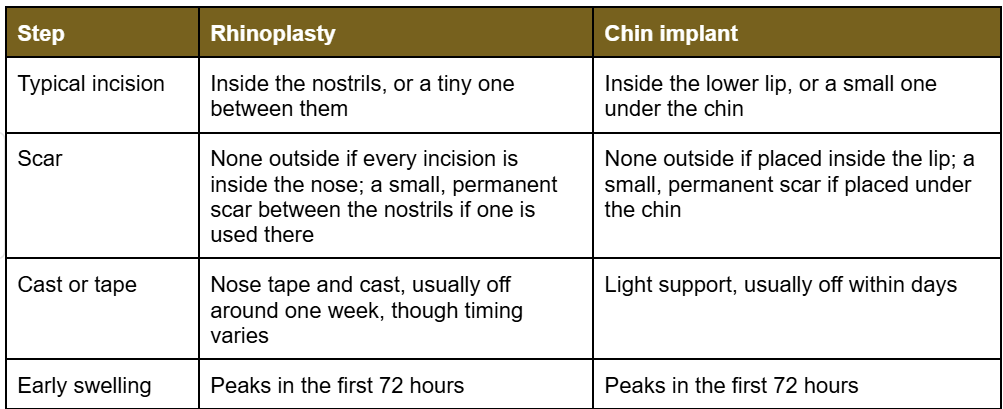
Bruising often peaks in the first three days, and tapes usually come off near the end of the first week. Initial bruising and swelling generally improve over the first several weeks. Subtle nasal swelling and final contour refinement may continue for 12 months or longer.
Being honest about trade-offs is part of good care. Potential chin implant complications include infection, implant displacement, asymmetry, temporary or persistent changes in sensation, and, occasionally, the need for additional surgery. The best way to understand your own risk is to raise it directly with Dr. Prendiville, who can walk you through his technique, your concerns, and the complications he has managed with chin implants over his career. If you want to see how the nose fits into the bigger picture, our rhinoplasty page is a good place to start, and the chin and neck relationship is closely related.
Megan, a Prendiville Facial Plastic Surgery patient who wanted a natural rhinoplasty result, shared this experience:
"My recovery wasn't painful at all. The hardest part was waiting two weeks to get the cast and tape off, to see the results! And the results are better than I could've imagined. I look like a refined version of myself."
This is where planning matters most. A lip lift, sometimes called a bullhorn lip lift, removes a thin strip of skin just under the nose. That raises the upper lip and shows a little more of the pink lip. A rhinoplasty may use a small incision on that same central strip of tissue. Because both draw on the same area, combining them takes extra thought.
The good news is that combining rhinoplasty with an upper lip lift may be appropriate for selected patients. Published research, including a systematic review and a separate study of combined cases, suggests that the two together can achieve favorable outcomes in these patients.
Still, the caution is real. Because both procedures involve tissues near the nasal base, careful surgical planning is essential to minimize risks involving circulation, wound healing, scarring, and changes in nasal or lip appearance. For that reason, some surgeons prefer to stage the two. When the procedures are performed separately, the recommended interval depends on tissue healing, the extent of the initial surgery, and the surgeon's assessment of blood supply and nasal stability.
Dr. Prendiville is a strong believer in the lip lift as a lasting option. He describes it as a natural way to refresh the upper lip without repeat filler visits. He sums it up as "That's easy, lip lift" when choosing between a lip lift and lip filler. Because he is the only surgeon in the practice, one person decides whether to combine or stage your procedures and then performs them. That keeps the plan consistent from start to finish.
Candidates are generally healthy, have a longer upper lip and a real nasal concern, and can stop all smoking and nicotine products, including vaping, patches and gum, as instructed. It is completely normal to feel unsure about doing two things at once. Speak directly with Dr. Prendiville about whether he would combine or stage your procedures, what worries you about doing both, and his own track record, complications included, with lip lifts alongside rhinoplasty.
Louise, a Prendiville Facial Plastic Surgery patient who had a lip lift as part of a combined procedure, shared this experience:
"The results so far exceed my expectations. I already look refreshed and natural. Dr. Prendiville's focus is ensuring patients still look like themselves, only sooo much better!"
For many patients, this is the most personal question of all. The worry is not just about the result. It is about losing what makes your face yours. Good ethnic rhinoplasty answers that worry directly. Its goal is to refine the nose while preserving your heritage, not to push every nose toward one Western ideal.
Ethnic rhinoplasty is individualized to each patient's anatomy, aesthetic preferences, and cultural identity. Depending on your goals, surgery may involve structural augmentation, reduction, refinement, or a combination of techniques. Imaging research shows that nasal skin thickness varies considerably among individuals. Thicker skin can limit the visibility of subtle cartilage refinements and may require adjustments in surgical technique and recovery expectations.
The table below matches common anatomical features with the approaches a surgeon may consider.
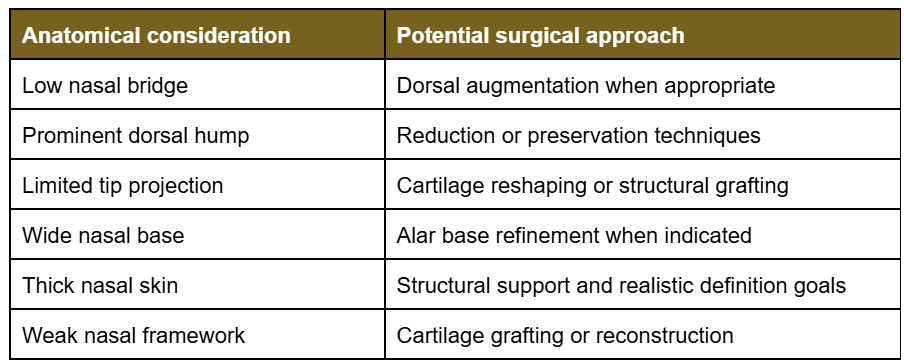
Cartilage from your septum, ear, or rib is commonly used to add height and support. Synthetic implants may be appropriate in selected cases, although each material has distinct risks and benefits. When indicated, a refinement called alar plasty can narrow a wide nasal base or ease nostril flare through a small, precise change.
One honest note on recovery: thicker skin holds swelling at the tip longer, so patience is part of the process. The reward is a nose that still looks like it belongs on your face. As the practice frames every rhinoplasty, the aim is that people "just see you, more aligned, more at ease, more you." Dr. Prendiville can tell you what he would recommend for your anatomy, talk through your concerns about preserving your features, and be open about the complications he has seen in his ethnic rhinoplasty patients.

If your first surgery did not turn out the way you hoped, the disappointment can run deep, and it is easy to feel you should have gotten it right the first time. Please set that guilt down. Revision rhinoplasty exists precisely because noses are complex and healing is unpredictable, and needing one does not mean you failed.
It is, however, among the most demanding facial procedures. Revision rhinoplasty may involve cosmetic refinement, functional correction, or structural reconstruction, and it is often more complex because previous surgery can alter anatomy and create scar tissue. A study of 92 revision patients at one specialized clinic found that almost two-thirds had both a cosmetic and a breathing problem. In that study, another revision was also more common after a revision than after a first rhinoplasty. Before deciding, put three things to Dr. Prendiville directly: how he would rebuild your nose, what worries you most about a second operation, and his experience and complication history with revision rhinoplasty.
Two challenges make this work hard. The first is missing structure. When too much cartilage or bone is removed the first time, the surgeon has to rebuild support with grafts. When the septum is used up, cartilage is borrowed from elsewhere. The American Society of Plastic Surgeons describes the common sources, shown below.
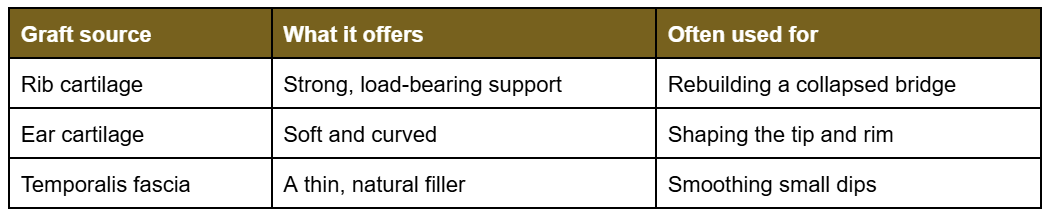
The second challenge is scar tissue. Scar tissue can alter normal tissue planes, elasticity, and vascularity, making revision rhinoplasty more technically challenging. So the surgeon has to work slowly and precisely to separate that scar tissue without harming the structures beneath. This is where a reconstructive background shows.
Dr. Prendiville trained in facial plastic and reconstructive surgery under a leader in the field. "I liked putting it back together more than I liked taking it apart," he has said of his path to reconstruction. His practice also welcomes patients recovering from prior nasal surgery, so revision is squarely within his focus.
Timing matters too. Standard clinical guidance is that elective revision rhinoplasty is commonly delayed until healing and swelling have stabilized, often approximately 12 months or longer. The practice follows nose patients for a year, watching things refine, before considering anything further. Certain complications may require earlier evaluation or intervention. Ethnic revision adds one more goal, restoring a nose that was over-refined or over-narrowed. A study of secondary rhinoplasty describes rebuilding and lengthening noses that were over-reduced, rather than reducing them further.
To learn more about the procedure itself, you can explore the practice's rhinoplasty page and see how this expertise is applied.
Lauren, a Prendiville Facial Plastic Surgery patient who chose a facial-only specialist for nose surgery, shared this experience:
"I met with 8 different plastic surgeons before choosing Dr. Prendiville. I personally did not want a 'jack of all trades' plastic surgeon operating on my face. The fact that Dr. Prendiville specializes exclusively in cosmetic and reconstructive facial plastic surgery weighed heavily into my decision. Every step has been nothing short of concierge-level care."
Come back to where this started: the nose is rarely the whole story. The through-line across every option here is the same. Whether it is the nose with a chin, the nose with a lip lift, an ethnic refinement, or a revision, the goal is balance and staying recognizably yourself. That is a decision about your whole face, not a single feature, and it deserves an unhurried conversation.
It is natural to save a photo of a nose you admire, and you are welcome to bring it. Just know the aim is a natural result that suits your face, not a copy of someone else's. If you are traveling for care, the practice sees many out-of-town patients and offers virtual visits, so you can begin from anywhere and recover in the Southwest Florida sunshine. You can learn more on the out-of-town page.
When you are ready, Dr. Prendiville and his team in Fort Myers would be glad to talk through what is possible, with the same promise behind every procedure: a refreshed, balanced result that still looks like you. Call 239-437-3900 or reach out through the contact page to request a private consultation, in person or virtually. Thank you for reading, and I hope this helps.
Yes, in many cases both can be done in one session to balance the profile. Combining them means one anesthesia, and both areas can recover during the same period, though swelling and recovery needs may increase with the extent of surgery. Ask Dr. Prendiville whether he would pair them for your profile; he can address your own concerns and tell you how often complications have come up when he combines the two.
It can. By bringing a modest chin forward into better proportion, a chin implant can make a prominent nose look smaller and more balanced, even before any change to the nose itself. This is exactly why surgeons assess the nose and chin together rather than one at a time.
Many people go back to desk work after one to two weeks, once the cast and tape are off, though timing varies. Initial bruising and swelling generally improve over the first several weeks, while subtle nasal swelling and final contour refinement may continue for 12 months or longer.
There is no fixed interval. When the procedures are performed separately, the recommended interval depends on tissue healing, the extent of the first surgery, and the surgeon's assessment of blood supply and nasal stability. Let Dr. Prendiville walk you through the spacing he would advise for you, any concern you have, and the complications he has seen in patients whose procedures he staged.
Cartilage from your own septum, ear, or rib is commonly used to build up the bridge. Synthetic implants may be appropriate in selected cases, although each material has distinct risks and benefits. Which material he would choose for your nose is a question to put to Dr. Prendiville directly, along with your concerns about each option and his history of complications with each material.
Yes. Even when too much was removed the first time, a surgeon can rebuild the nose using cartilage borrowed from the rib or ear. It is careful, reconstructive work. At consultation, Dr. Prendiville can explain how he would rebuild your nose, hear what you hope to restore, and describe his complication record with rebuilding over-reduced noses.
Elective revision is commonly delayed until healing and swelling have stabilized, often approximately 12 months or longer. Certain complications may require earlier evaluation or intervention. Operating too early means working on a nose that is still changing.
Combining two procedures into one operation generally means a single anesthesia and one facility visit instead of two, which many patients find more efficient than staging them separately. The specifics of your own cost are reviewed privately at your consultation rather than quoted online.
Disclaimer: This article is for educational purposes only and is not medical advice. Individual results vary and are not guaranteed. Consult a qualified, board-certified facial plastic surgeon to determine the treatment that is right for you.

