
Those soft pockets along the jaw have a name. They are jowls, and they are one of the first places the lower face shows its age. Creams, fillers, and energy devices can help in the early stages. When jowling is primarily caused by structural tissue descent, surgery provides the most direct method of repositioning tissue. Nonsurgical treatments may offer limited improvement in selected patients but do not reproduce a surgical lift.
The good news is that the results are real. A well-done lower face lift can take years off how old you look, restoring the jawline in a way creams and devices cannot. At Prendiville Facial Plastic Surgery in Fort Myers, Florida, double board-certified facial plastic surgeon Dr. Stephen Prendiville has focused only on the face for 25 years.
This guide walks through why jowls form, the surgical options that lift them, what the procedure involves, what recovery looks like, and the results you can expect.
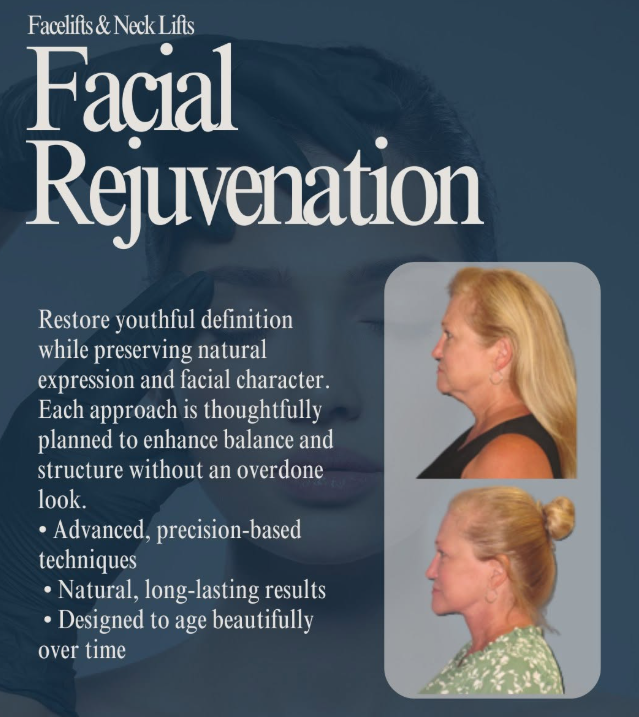
Jowls are not just loose skin. They are a layered change in the lower face, and understanding the layers explains why surgery works when other things stop working.
Three things happen together as the lower face ages:
There is a reason photos can look worse than the mirror. The bone along the jaw also thins with age. The dropped fat then sits against a flatter edge, which deepens the shadow and makes the sag look sharper from the side.
This is also why creams and quick fixes feel let down here. Fillers and skin-tightening devices can hide mild jowling. But they cannot lift tissue that has truly dropped. It is normal to try the gentler route first. When the change is structural, surgery is what restores the line. The clearest way to know which camp you are in is to talk it through with Dr. Prendiville, who can walk you through his own technique, your individual concerns about risks and complications, and what he has seen across his own patients.
There is no single jowl operation. There is a spectrum, and the right choice depends on how much the lower face and neck have changed. Here are the main options at a glance.
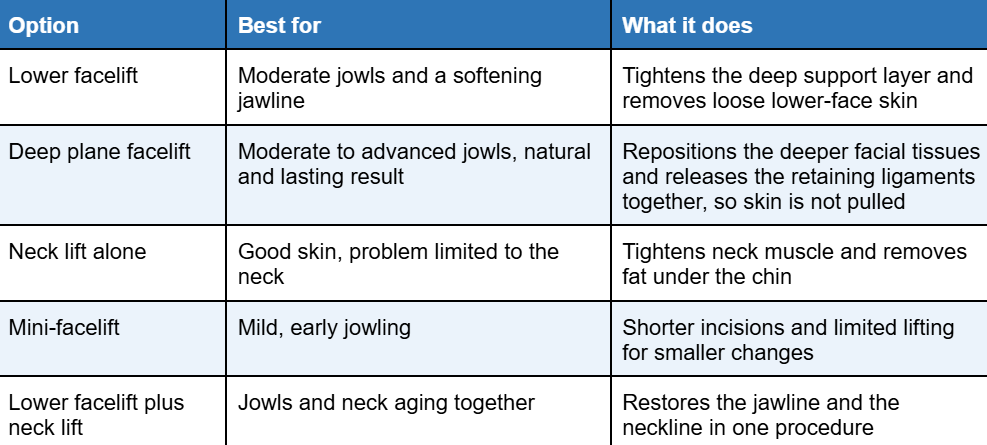
The deep plane facelift is one of the leading modern facelift techniques for jowls. Instead of tightening only the surface, it works beneath it to free the ligaments and move the deeper tissue back into place. A 2025 systematic review of 21 studies and nearly 2,900 patients found a 94.4 percent satisfaction rate for deep plane facelifts. The older SMAS technique came in at 87.8 percent.
This is the approach Dr. Prendiville has built his practice around. His own version is the Prendiville Signature Lift™, a deep plane facelift shaped to each face. As he performs it, a deep plane facelift also includes a deep neck lift: removing the fat that sits beneath the platysma, thinning the small muscles under the chin, and reducing the salivary glands along the jaw. That deeper neck work is not needed for every patient, but it is commonly done and greatly improves the neck result. As he explains it, the best neck lift is really a facelift. Lifting the deep layer with a backward pull is what re-shapes the jawline and the neckline in a coordinated manner. For a problem centered under the chin, deep neck contouring can be done on its own or folded into the lift.
Choosing among these options is exactly what a consultation is for. If you are weighing your choices, you can request a private consultation, in person or virtually, to talk through what is bothering you and see what fits.
Deborah, a Prendiville Facial Plastic Surgery patient who chose a deep plane facelift and neck procedure, shared her experience:
"I was nervous about getting such a major surgical procedure but after meeting Dr. Prendiville and his staff I felt so much more at ease and excited. I booked a facelift and neck, deep plane."
Knowing the steps takes much of the worry out of the decision. A jowl lift, or lower facelift, is a careful, well-mapped operation, and most of it is about the layer you cannot see.
Incisions are tucked into natural lines around the ear. They start in the hairline, trace the front edge of the ear, slip under the earlobe, and continue behind the ear into the hairline. Placed this way, the lines settle into folds the eye already expects.
This is the real work. The deep support layer, called the SMAS, is either folded and stitched or, in a deep plane lift, freed from underneath. An anatomical reference explains how freeing those ligaments lets the tissue carry the lift, so the skin is not pulled tight. In his own surgical videos, Dr. Prendiville shows how moving the deep structures together creates a natural angle along the jaw.
Stubborn fat along the jowl and under the chin is often removed with a fine tube before the deeper lift. The neck is shaped at the same time. In Dr. Prendiville's deep plane lift this often includes the deeper neck work described above, along with a small muscle tightening and a supportive sling that holds the jawline. Because one surgeon plans and performs every step himself, the face and neck are balanced as a single result.
Finally, the skin is laid gently back over the restored structure and the small amount of excess is trimmed. A standalone jowl lift usually takes about two to three hours, under general anesthesia or local anesthesia with sedation. It runs longer when combined with other procedures.
Recovery is more manageable than most people fear, and it happens in clear stages. Dr. Prendiville is candid with patients about what each week feels like. The timings below are general. How fast you heal depends on how extensive the surgery is, whether it is combined with other procedures, and your own health, anatomy, and healing.
In his practice, most facelift patients wear no dressing the first night, and small drains stay in for about two days to clear fluid and help the skin settle onto the deeper tissue. Stitches and staples in the hairline usually come out around day seven. For the first two weeks you are asked not to bend over or lift anything heavy, but walking is encouraged from the start. For most people, it is not very painful.
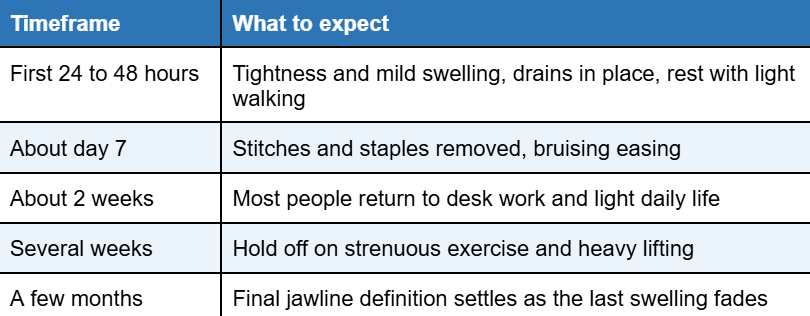
Swelling and bruising are worse in the first few days and ease over the next couple of weeks. Most people are back to desk work in about two weeks. At a six-week check, one of his patients said she felt completely normal, with a clean jawline already showing. That was her experience, and healing runs at a different pace for everyone. The final result keeps settling over the next few months, which is why follow-ups continue at around three months.
This is also where being out of town stops being a barrier. The practice supports travel and recovery-away patients with virtual consultations and concierge care, so you can heal close to home and stay in touch.
If you want to learn more before you decide, you can read about the deep plane facelift in detail, then request a private consultation when you feel ready.
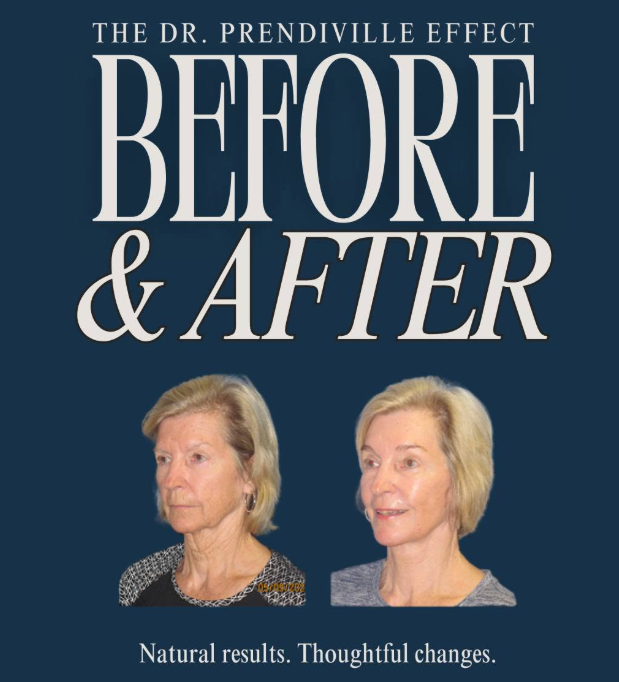
The goal is not a new face. It is your own jawline, restored, so you look rested rather than operated on.
Deep plane results last. Because the lift is carried by the deep tissue instead of the skin, it holds its shape longer than a skin-only or traditional SMAS lift. Over the years, it also tends to need far fewer revision touch-ups. Dr. Prendiville frames it simply, in terms of how many years he can take a patient back while keeping the result natural.
How long your result lasts depends on more than the technique. Your age, skin quality, and genes all play a part. So does daily life. Sun and smoking break down collagen and shorten the result. Good skin care and the odd touch-up help it last. A facelift does not stop aging, and no procedure has a guaranteed lifespan. He performs jowl lifts for patients in their 50s through their 70s, and sometimes older. The best age, he says, is simply when real changes are present and your health is good.
Rose, a Prendiville Facial Plastic Surgery patient who no longer hides her jawline from the camera, shared her experience:
"I had a lower face lift done by Dr. Prendiville and the results are A-MAZING. Friends and family say I look the same as I did 10-15 years ago. When I look in the mirror I see myself, not the person with the heavy neck and jowls that refused pictures."
Think back to that photo that gave you pause. The heaviness along the jaw that did not match how you feel is a normal part of aging, and for many people a lower face lift can quietly restore that line.
If you want to see what is possible, the next step is a calm one. A private consultation, in person or virtually, is where you talk through what bothers you, review your goals and health, see real before-and-after results, and leave with a plan built for your face. There is no rush and no pressure.
When you are ready, Dr. Prendiville and the team in Fort Myers, Florida would be glad to help you explore your options. You can request a private consultation or call the practice at 239-437-3900. The aim, as always, is a result that still looks like you, only refreshed.
A jowl lift, usually done as a lower facelift, focuses on the bottom third of the face, including the jowls, jawline, and upper neck. A full facelift addresses a broader area. Many patients only need the lower-face approach to restore a clean jawline.
There is no single right age. What matters most is having real aging changes present and being in good health. Dr. Prendiville performs jowl lifts for patients in their 50s through their 70s, and sometimes older, so the best time is genuinely when it is right for you.
Often, yes, but usually as part of the plan rather than the jowl lift alone. The vertical bands come from the platysma muscle, so they are typically treated by tightening that muscle during a combined neck procedure. Dr. Prendiville can confirm whether you need both, and explain how he approaches the platysma in his own technique and what he has seen in his own patients.
It can be done under general anesthesia or under local anesthesia with sedation, depending on the plan and your health. A standalone jowl lift usually takes about two to three hours. Combining it with other procedures adds time.
Sometimes, but only when the fat is isolated and the skin still has strong elasticity, which is more common in younger patients. If the skin is loose or the deeper tissue has descended, removing fat alone can make sagging look worse. In most cases of true jowling, a lift is needed to reposition the tissue. Whether it is the right choice for you is best settled with Dr. Prendiville directly, including your own concerns about risks and complications and his experience with them.
Most people return to desk work in about two weeks, once stitches are out and the early swelling has eased. Jobs that involve heavy lifting or strain need more time. Light walking, though, is encouraged from the first days.
For many patients with sagging jowls, the deep plane technique offers a more natural and longer-lasting result, because it moves the deeper layer rather than just tightening the surface. It also tends to bring higher patient satisfaction and fewer revisions over time. The right choice still depends on your anatomy and goals. Dr. Prendiville can talk you through how he approaches each technique, your own concerns about risks and complications, and what he has seen across his own patients.
Disclaimer: This article is for educational purposes only and is not medical advice. Individual results vary and are not guaranteed. Consult a qualified, board-certified facial plastic surgeon to determine the treatment that is right for you.

