
Because the techniques differ, there is no single best facelift. The right technique is the one matched to your face, your goals, and how your skin has aged. As Dr. Stephen Prendiville puts it, "Not all facelifts are the same. Each technique offers a different approach. The key is choosing what's right for you."
Facelifts are also more common, and more varied, than many people think. A 2025 AAFPRS survey found that patients aged 35 to 55 may represent up to 32 percent of facelift patients. Many of them choose lighter, partial lifts. The options have widened, which is exactly why understanding them matters.
That is what this guide is for. The practice, Prendiville Facial Plastic Surgery in Fort Myers, Florida, has focused only on the face for 25 years, with one surgeon performing every procedure. Below, we compare the main types of facelifts, what they cost, what recovery is like, and how to find the one that fits you.
A facelift is not one operation. It is a family of techniques. The names describe how deep the surgeon works and which part of the face is treated. A full or "traditional" facelift is mostly everyday language. When a facial plastic surgeon says facelift, they usually mean the cheek, the jawline, and the neck.
Here are the main options at a glance:
The non-surgical choices are gentler, but their numbers tell a careful story. A 2026 review of thread-lift outcomes of 2,827 patients found frequent short-term effects. These included swelling in 34 percent and skin dimpling in 7 percent of cases, though the studies varied widely. Those are pooled research figures, not a prediction of what any one patient will experience. Threads can refresh, but they do not replace surgery.
One related procedure comes up here too, the brow lift. It is really a brow relaxation, usually an endoscopic brow lift done through small incisions in the hairline. The goal is a softer brow, not a raised one. Overly lifted brows are one of the things that read as "done." There is also a gentle caution worth hearing about chasing the smallest operation. Smaller incisions sound appealing. But what a lighter lift does not address can make all the difference. That trade-off between depth and effort is the heart of the comparison.

Almost every modern surgical facelift is built on one of two methods. Both work below the skin, on a layer called the SMAS. The SMAS is the sheet of muscle and tissue that supports your face. The difference is how deep the surgeon goes and what they do once they are there.
Dr. Prendiville explains it in plain terms. A SMAS lift raises the skin out toward the smile line and lifts the SMAS as its own layer. A deep plane lift raises the skin only partway. Then it works beneath the SMAS and the deeper muscles, repositioning the deeper facial tissues in a coordinated manner, and it may be combined with individualized neck-lift techniques. Because that deeper layer holds the tension, the skin is closed with none. In his words, you pull on the carpet liner, the SMAS, so you can trim the extra carpet and lay it down smoothly.
What sets the deep plane apart is that it releases the facial retaining ligaments. These are the small anchors that tether the SMAS to the bone. Per surgical anatomy references, a SMAS lift generally leaves those anchors in place. A deep plane lift frees them, which allows a more vertical lift and can help avoid the pulled, windswept look.
The outcomes data leans toward the deeper technique. A 2025 review of 2,896 patients reported a 94.4 percent satisfaction rate for deep plane facelifts, compared with 87.8 percent for SMAS lifts. Deep plane results also tend to be very long-lasting, generally holding longer than a SMAS lift, which is part of their appeal. A facelift does not stop aging, and no procedure has a guaranteed lifespan.
Honesty matters here, because deeper is not automatically safer. That same review found a higher overall complication rate for deep plane lifts, 17.2 percent versus 10.3 percent. The reassuring part is nerve safety. A review comparing the two techniques found similar temporary nerve-injury rates for both, with permanent injury very rare.
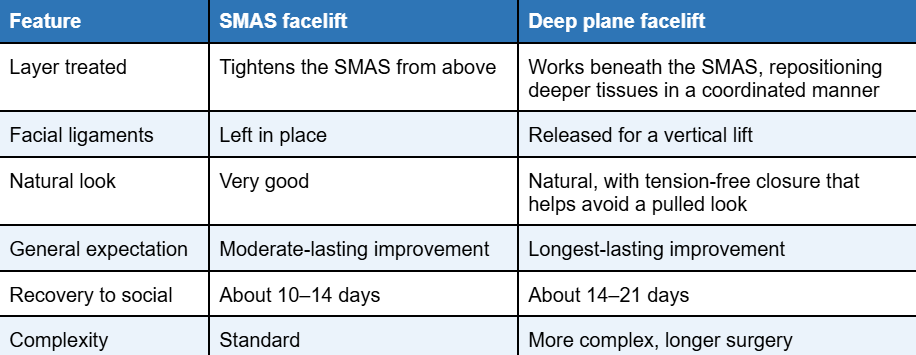
The deep plane is the technique behind the Prendiville Signature Lift™, which lifts the deeper structures while keeping the result soft and natural. Dr. Prendiville's deep plane facelift also includes a deep neck lift, which involves removing subplatysmal fat, debulking the anterior bellies of the digastric muscles, and debulking the submandibular glands. This is not necessary for every patient, but it is commonly performed and greatly enhances the neck results. It is a lot to take in, and you do not have to sort it out by yourself.
Louise, a Prendiville Facial Plastic Surgery patient who chose a deep plane facelift, shared her experience:
"I recently underwent a deep plane facelift, CO2 treatment, and lip lift with Dr. Prendiville, and I could not be more thrilled with my experience. From my very first consultation, I felt completely confident and at ease."
If you are weighing these two techniques, the next step is to learn which one fits your anatomy. You can request a private consultation, in person or virtually, whenever you are ready.

Cost is a fair question, and it deserves a straight answer. The figures below are national U.S. averages from published industry data. They are not the pricing at this or any one practice. Every surgeon prices differently, and your own cost is something you review at a consultation, not off a web page.
With that said, here is how the main options tend to compare nationally.
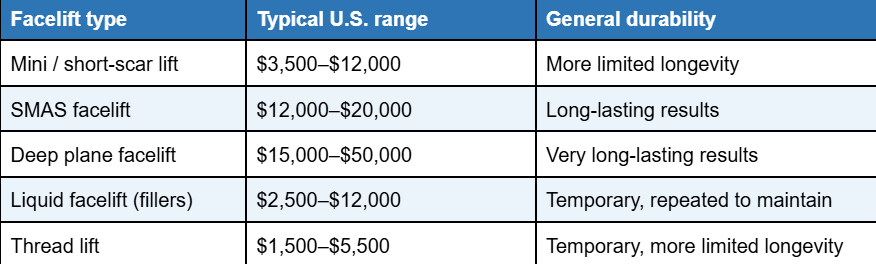
The per-technique ranges above are broad market estimates gathered from published consumer sources, not figures published by a medical society. A few drivers explain the spread. According to the American Society of Plastic Surgeons' 2024 fee data, the average surgeon's fee for a standard facelift runs roughly $12,000 to $19,000. That is only one line in the bill. An all-inclusive quote usually folds in the operating room, anesthesia, garments, medication, and follow-up care. Surgeon experience and geography also move the total, with coastal cities often charging a premium.
It also helps to think about value over time. A deep plane lift costs more upfront, while non-surgical maintenance is repeated periodically and can quietly add up over the years.
None of this tells you what your procedure will cost. It only frames the question. The real number depends on your anatomy and your plan, and that is reviewed privately.
Recovery is often the deciding factor, and it tracks with how deep the surgery goes. A mini lift involves the least work and asks for only about 5 to 7 days of social downtime. A deep plane lift moves the deeper layers. Most patients plan on 10 to 14 days before desk work, and two to three weeks before they feel ready to be seen.
It helps to think of healing in two phases. There is physical recovery, the swelling and bruising. Then there is the point where you simply feel good about how you look again. Discomfort, swelling, bruising, tightness and numbness vary from patient to patient. Dr. Prendiville sets the timing for suture removal, makeup and a return to normal activity based on your own recovery.
The day-by-day picture for a deep plane lift follows a broad pattern, though how strong it is and how long it lasts vary from patient to patient. Swelling and bruising usually peak around days three and four. Sutures come out and most patients are comfortable leaving the house with a hat and sunglasses by days five to seven. Bruising mostly fades by three weeks. Subtle swelling and some numbness around the ears and cheeks can linger for a few months.
A few things can support healing. Keeping your head elevated for the first week reduces swelling. Many practices now use enhanced recovery protocols with gentle early movement and non-opioid pain control. Scars settle quietly too. When incisions are placed at the edge of the ear and the skin is closed without tension, the lines stay hard to see as they fade over six to twelve months. Scars are permanent, and how they finally look varies from person to person.
For patients who live elsewhere, recovery away from home is a well-worn path. Prendiville Facial Plastic Surgery runs a concierge program for out-of-town and virtual patients, with a virtual consultation, a custom plan, and help arranging a local stay. Dr. Prendiville advises how long to stay nearby and when it is safe to fly, based on your procedure and how your recovery is going. If traveling for surgery is on your mind, that page explains how it works.
This is where the names finally fall away. The best technique is not the trendiest one. It is the one matched to your face. A handful of factors guide that match, and a good surgeon weighs them together.
Your degree of sagging and skin quality come first. Mild, early laxity often does well with a lighter SMAS or mini approach. Heavier tissues and deeper midface sagging usually call for a deep plane lift to release the ligaments. A 2024 review in Annals of Plastic Surgery lays out exactly this kind of matching, from skin tone to bone structure.
Age and goals matter too. There is no perfect age. Dr. Prendiville performs facelifts for patients in their 50s, 60s, 70s, and sometimes 80s. He tells people the right time is when you are in good health and the aging changes are actually there. He also reminds patients that the face and neck age together, so for many people the best neck lift is part of a deep plane facelift, not a neck procedure done alone.
Then there is the surgical-versus-non-surgical question. Lighter treatments have their place. According to AAFPRS data, non-surgical procedures make up about 80 percent of cosmetic work, and they shine for early aging. But they offer less and less once sagging becomes structural. No filler can reposition tissue the way surgery does.
The most important factor, though, is the surgeon. The technique only works in skilled hands. One simple test you can act on is this. Any surgeon you consider should show you their own before-and-after patients, not someone else's. In a facial-only practice where one board-certified surgeon performs every procedure, that consistency is the whole point.
Ana, a Prendiville Facial Plastic Surgery patient who valued a surgeon who recommends the right procedure rather than the biggest one, shared her experience:
"Certified and experienced Doctor, expert on face and neck lifts, supported by an excellent staff, outlines the best procedures for each case without forcing products or services."
Remember where you started, staring at a wall of facelift names and wondering which one was yours. You do not have to crack that code alone. The names matter far less than the match, and a good surgeon's job is to find the technique that fits your face and your goals.
The simplest next step is a conversation. Dr. Prendiville and his team in Fort Myers care about one thing above all, a result that still looks like you, only refreshed and rested. The most reliable way to know whether a procedure suits you is to talk it through with Dr. Prendiville directly, his techniques, your own concerns about risks and complications, and his experience with the procedure. If you would like to talk through your options, request a private consultation, in person or virtually, or call the practice at 239-437-3900. We would be glad to help.
Not a true one. Non-surgical options like fillers, threads, and energy devices can soften early aging or delay surgery. But they cannot reposition deeper tissue or remove loose skin. They work best as a complement to surgery, not a replacement for it.
There is no official minimum age. The better question is not your age, but whether real aging changes are present and your health supports surgery.
A mini lift gives more limited longevity than a full lift, and aging continues its natural course underneath it. A deep plane lift is designed for a more comprehensive and potentially longer-lasting result. The trade-off is a smaller procedure and a faster recovery.
Yes, and many patients do. A facelift is often paired with eyelid surgery, a brow lift, or fat transfer for a balanced, all-over refresh. Combining procedures in one session can also mean a single recovery rather than several.
No. A facelift lifts the cheeks, jawline, and neck, but it does not treat crow's feet or under-eye concerns. Those usually call for eyelid surgery, laser resurfacing, or injectables, which can be planned alongside a lift.
The American Society of Plastic Surgeons reports a projected surgeon's fee of roughly $12,000 to $19,000 for facelift surgery, and a deep plane lift sits at the higher end of that range. That is the surgeon's fee alone; the totals in the table above also fold in the facility, anesthesia and follow-up care. These are general U.S. figures, not a quote. Your own cost depends on your plan and is reviewed at a private consultation.
The technique is more complex. Working beneath the SMAS and around the facial nerves takes more surgical time and advanced training, which is reflected in the fee.
A mini facelift still leaves permanent scars, but in most cases they are well hidden. Incisions are tucked along the ear, the temple, and the hairline, and they fade over several months as they heal. How they finally look varies from person to person.
Not always. If you are happy with your cheeks and midface but bothered by neck laxity, a standalone neck lift can be appropriate. For many patients, though, the neck and lower face age together, so treating both gives the most harmonious result.
Not really. Thread lifts offer a mild, temporary lift with more limited longevity. They cannot remove excess skin or restructure deeper tissue. They can be a reasonable touch-up for early changes, but they do not match a surgical result.
Disclaimer: This article is for educational purposes only and is not medical advice. Individual results vary and are not guaranteed. Consult a qualified, board-certified facial plastic surgeon to determine the treatment that is right for you.

