Rhinoplasty is surgery to reshape the nose. It can change the size, shape, and proportions of the nose, and in many cases it can improve how well you breathe. Doctors call it rhinoplasty. Most people call it a nose job, and they mean the same thing. In one 2024 study, most patients reported better satisfaction and quality of life six months after cosmetic rhinoplasty.
At Prendiville Facial Plastic Surgery in Fort Myers, Florida, double board-certified facial plastic surgeon Dr. Stephen Prendiville has focused only on the face for 25 years. He describes rhinoplasty as reshaping the nose. His goal is always balance, never change for its own sake. This article covers what rhinoplasty can change, the main types, open versus closed surgery, the techniques a surgeon uses, and the step-by-step procedure.
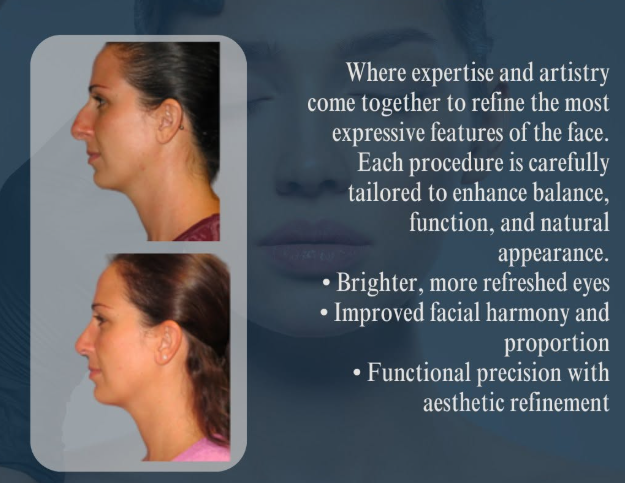
Rhinoplasty can change the size, shape, and proportions of the nose so it fits the rest of your face. It can smooth a bump on the bridge, refine a bulbous or droopy tip, narrow wide nostrils, and straighten a crooked bridge. Even a change of a few millimeters can noticeably shift how the whole face reads.
It is also honest to say what surgery cannot do. It will not recreate someone else's exact nose or change your genetics or skin quality. The focus is on contour and proportion, not on skin concerns like redness or spots. What is realistic for your own nose is worth asking in person: speak directly with Dr. Prendiville about how he would approach it, what you hope to change, and his own experience and complication history with rhinoplasty.
Many people come in for breathing, not just looks. A deviated septum, which is a crooked middle wall inside the nose, can block airflow. Fixing it can bring real relief. One 2017 meta-analysis of 16 studies found that nasal blockage scores dropped by about 43 points 6 to 12 months after this surgery. That is a pooled average across studies, not a prediction for any one patient. Rhinoplasty can also repair the nose after an injury, correct a difference present at birth, or fix a past nose surgery.
It is completely normal to feel self-conscious about a feature that sits at the center of your face. Dr. Prendiville often reminds patients that the nose draws attention because it is central, so a balanced nose lets the eyes and smile lead instead. If you want to explore the surgical side in more detail, you can read about the practice's approach to rhinoplasty and what the experience involves.
Danielle, a Prendiville Facial Plastic Surgery patient who cared about both looks and breathing, shared this experience:
"My experience with Dr. Prendiville was amazing from start to finish. In the initial consultation, he answered all my questions and made me feel at ease with the procedure. In the weeks and months that followed, I got to witness Dr. Prendiville's beautiful artistry unfold as I healed. Additionally, I could also breathe so much better than before my surgery."
Not every nose job is the same. The type of rhinoplasty depends on what you want to change and whether the goal is looks, breathing, or a mix of both.
Cosmetic rhinoplasty improves the shape and size of the nose so it fits the chin and the rest of the face. Functional rhinoplasty aims to improve breathing by correcting structural problems such as nasal valve collapse, while septoplasty corrects a deviated septum. Cosmetic and functional goals often overlap in one surgery.
Revision rhinoplasty, also called secondary rhinoplasty, is done after an earlier nose surgery. It corrects a lasting shape or breathing problem, and it tends to be harder to repair. Revision surgery is sometimes necessary, but it is not routinely expected. In one large 2016 registry study of more than 175,000 septorhinoplasty patients in three states, 3.3 percent had a revision over at least three years of follow-up. That is the study's overall rate, not a prediction of any one person's risk.
Nonsurgical rhinoplasty uses injectable fillers to smooth a small bump or lift the tip without surgery. It is temporary, and its effect fades over months, with timing that varies by filler and person, per a StatPearls review. Here Dr. Prendiville is candid. Filler in the nose, he explains, is really not a rhinoplasty, and it has narrow uses. Although most nasal filler treatments do not result in serious complications, the nose is considered a high-risk injection site because of its vascular anatomy and connections to the blood vessels supplying the eyes. Nasal fillers carry rare but serious risks, including tissue necrosis, vision loss, and blindness from vascular occlusion. Dissolving hyaluronic acid filler does not guarantee the damage can be reversed, permanent fillers are generally discouraged in the nose, and dermal fillers are not FDA-approved specifically for the nose. If you are weighing filler against surgery, speak directly with Dr. Prendiville about his techniques, your own worries about these risks, and his experience and complication history with both.

Septoplasty can be done on its own, purely to improve breathing, or combined with rhinoplasty, which surgeons then call a septorhinoplasty. Knowing which type fits your goal leads naturally to the next choice, how the surgery is actually approached.
Open and closed rhinoplasty describe where the incisions are made. In closed rhinoplasty, all the incisions are placed inside the nostrils, so there is no external scar. In open rhinoplasty, the surgeon adds a small incision across the columella, the strip of skin between the nostrils, which is joined to the internal incisions. That extra step gives a direct view of the framework.
The choice is not one size fits all. Both approaches can address complex anatomy, and which one fits depends on the surgeon's technique and experience and on your anatomy. The open view gives direct access for placing grafts, while the closed approach avoids an external incision. This is where an experienced, facial-only surgeon earns their value. Dr. Prendiville matches the approach to your nose and your goals, not to a single habit.

Worries about scarring are common. The open-approach scar is permanent, and how it looks once healed varies from person to person. In one study of open rhinoplasty in South Korea, 14 of 234 patients followed for at least six months (6 percent) had a problematic columellar scar, such as a widened, notched, or darker scar. A separate study of 77 patients, using the SCAR-Q patient questionnaire a year after surgery, found no difference in how patients rated scar appearance, symptoms, or psychosocial impact between the two approaches. Recovery is much the same too. Open surgery can bring a little more early tip swelling. Even so, a meta-analysis of 1,067 patients found no real difference in swelling or bruising by day 7. To decide between them, speak directly with Dr. Prendiville about how he approaches noses like yours, what worries you about scarring or swelling, and his own experience and complication history with each approach. You can talk it through at a private consultation, in person or virtually.

Once the framework is exposed, the surgeon uses a set of techniques to reshape the bone and cartilage. Each one has a clear job, and knowing the words helps you follow your own surgical plan.
Septal work is often part of the same surgery. The surgeon straightens a deviated septum while saving a supporting strut of cartilage. The removed cartilage can then be reused as a graft. There is also more than one way to lower a bridge. Dorsal preservation, an established technique that has regained popularity, lowers the intact bridge instead of removing the hump. Hump recurrence is a recognized possibility, but the comparative risk depends on the technique and on patient selection. Because the right technique depends on your anatomy, speak directly with Dr. Prendiville about which method he would use for your bridge, your concern about a returning bump, and his experience and complication history with it.
Seeing the surgery as a sequence takes away a lot of the mystery. Most rhinoplasty follows the same clear path from start to finish.
How long does rhinoplasty surgery take? It depends on how complex the case is. Simpler cases tend to run shorter, and complex or revision work takes longer. Dr. Prendiville performs every step of your surgery himself. He also follows patients as the nose keeps refining, long after the cast comes off. The practice cares for you in an accredited in-office surgical suite with discreet recovery support. Before you decide, speak directly with Dr. Prendiville about his surgical plan for you, any questions about anesthesia or recovery, and his own experience and complication history with rhinoplasty.
Megan, a Prendiville Facial Plastic Surgery patient who had a rhinoplasty and lived the recovery firsthand, shared this experience:
"I had a rhinoplasty with Dr. Prendiville in April 2024, and had a wonderful experience. My recovery wasn't painful at all, the hardest part was waiting two weeks to get the cast and tape off, to see the results! And the results are better than I could've imagined. I look like a refined version of myself."
You started by looking in the mirror and wondering what a small change might do. The honest answer is that the best result depends on your goals, whether you want a cosmetic change, better breathing, or both, and on the judgment of an experienced surgeon.
When you are ready, the next step is simple. A private consultation is where you talk through what bothers you, review your health history, and see what is realistically possible for your nose, in person or virtually. It is a calm conversation, not a commitment.
The whole philosophy at the practice is quiet and natural. Dr. Prendiville aims for a nose that sits in balance with the rest of your face, so your eyes and smile lead. To learn more or to plan a visit to the Fort Myers practice, reach the team at 239-437-3900 or through the contact page. We hope this has been helpful, and thank you for reading.
There is no difference. Rhinoplasty is the medical term, and nose job is the everyday word for the same surgery. Both describe reshaping the nose for looks, for breathing, or for both.
Most rhinoplasty is an outpatient facial cosmetic surgery that takes about 1 to 3 hours. Simpler cases run shorter, and complex or revision cases can take longer. Your surgeon can estimate your time once your plan is set.
Most patients are surprised by how manageable it is. Pain is usually mild to moderate rather than severe, and any real discomfort tends to ease within the first few days, though this varies. Congestion and the feeling of a blocked nose often bother people more than pain.
With closed rhinoplasty, all the incisions are inside the nostrils, so there is no external scar. With open rhinoplasty, there is a small incision across the columella, which leaves a permanent scar whose final look varies from person to person. Speak directly with Dr. Prendiville about where he places the incision, your scar concerns, and his complication history with open rhinoplasty.
Much of the initial swelling improves during the first several months. Refinement commonly continues for 12 months and sometimes longer, particularly after extensive tip work or in patients with thicker skin, so the final shape appears gradually.
Many people return to work or school in about 1 to 2 weeks, once the splint, tape, and sutures come off, though timing varies. Desk work is easier to return to than heavy activity. Your surgeon will guide you on when to resume exercise.
Yes. When breathing is the concern, functional rhinoplasty is often combined with a septoplasty to straighten the septum. This opens the airway and can relieve long-standing nasal blockage. The same surgery can address the outside shape at the same time. Speak directly with Dr. Prendiville to learn whether your breathing needs this, raise your own concerns, and ask about his experience and complication history with septorhinoplasty.
Like any surgery, rhinoplasty carries some risk, including bleeding, infection, and shape irregularities, and some patients have lasting breathing concerns. Nonsurgical filler carries its own rare but serious risks, including tissue necrosis and vision loss from vascular occlusion. For your own risk, speak directly with Dr. Prendiville about his techniques, the concerns you bring, and his complication history with rhinoplasty.
Disclaimer: This article is for educational purposes only and is not medical advice. Individual results vary and are not guaranteed. Consult a qualified, board-certified facial plastic surgeon to determine the treatment that is right for you.

