
Published research reports high satisfaction with both approaches. A 2025 systematic review and meta-analysis of 21 studies covering 2,896 patients found pooled satisfaction of 94.4 percent for deep plane facelifts and 87.8 percent for SMAS facelifts. Both are strong numbers, and neither settles which technique is right for any one face.
This is the heart of what makes a good facelift. At Prendiville Facial Plastic Surgery in Fort Myers, Florida, Dr. Stephen Prendiville is a double board-certified facial plastic surgeon who has spent 25 years focused only on the face. This guide walks you through what a natural result really looks like and the techniques behind it. It also covers why your own anatomy matters, the procedures that support a lift, and what recovery involves.
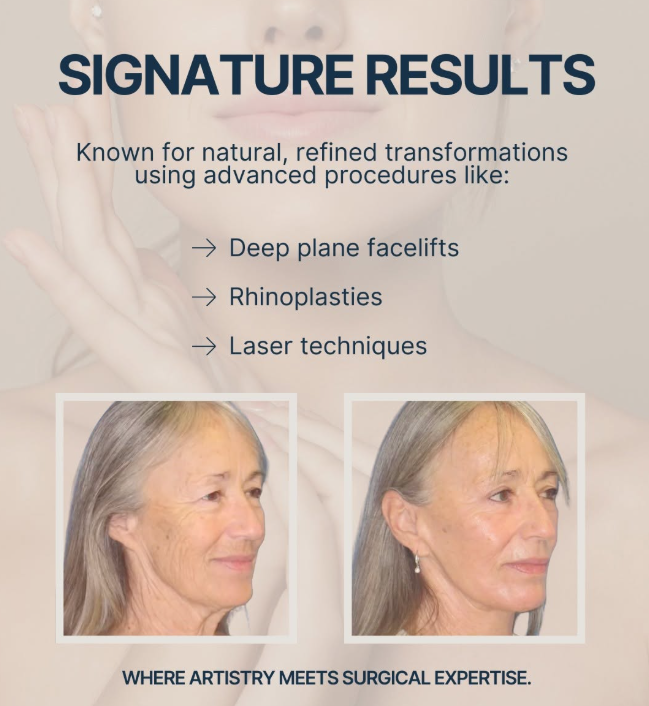
A natural result is one that does not announce itself. Your friends notice that you look well-rested or ask if you have been on vacation. They do not see a facelift. The face still moves the way it always did, the proportions still feel like you, and the line from the cheek to the jaw to the neck looks smooth and unbroken. What counts as a natural result is personal, and it is worth talking through at your consultation.
The opposite is the "windswept" or pulled look, and it can come from more than one thing: too much tension on the skin, or an approach that was not a good match for the face in front of the surgeon. Older skin-only methods stretch the skin sideways to tighten it. That flat, stretched-back look is exactly what people fear. Modern facelifts avoid it by lifting the deeper tissues upward. They follow the natural path your face has settled into over the years.
Preserved expression matters just as much as contour. A surgical anatomy reference counts around 30 muscles on each side of the face, including the ones that shape a smile or a raised brow. A careful lift protects them, so the warmth and life in your face stay intact. Because the work happens close to the facial nerves, nerve injury is a recognized risk of any facelift, and careful technique is meant to keep that risk low rather than remove it. The surgical "tells" also disappears. A pulled-down earlobe, called a pixie ear, is a known sign of a skin-only lift closed under too much tension. One study traces earlobe distortion to a few causes, including removing too much skin, an unbalanced lift direction, and tension carried through the deeper layer. A deep, tension-free closure is designed to avoid it.
This is the philosophy Dr. Prendiville returns to again and again. As he describes it, the goal is a balanced look that does not change who you are. He deliberately avoids pulling the muscle around the mouth, because that is what creates the strange, wide-mouth appearance. Many of his patients say the same thing afterward. They simply feel like themselves again. You can see that natural-results approach across his Prendiville Signature Lift™ work.
Louise, a Prendiville Facial Plastic Surgery patient who wanted a refreshed look she felt confident in, shared her experience:
"I recently underwent a deep plane facelift, CO₂ treatment, and lip lift with Dr. Prendiville, and I could not be more thrilled with my experience. From my very first consultation, I felt completely confident and at ease."
If the look depends on lifting the deeper layer, the natural next question is which technique does that best.
Deep plane is one established technique for facial rejuvenation, and it can offer real advantages for the right patient. Good natural-looking results are possible with more than one technique. Which one suits you depends on your anatomy, how your face has aged, your goals, and your surgeon's judgment. In plain terms, a deep plane lift moves the skin and the deeper support layer together as one unit. The skin comes along for the ride rather than carrying the load.
Dr. Prendiville explains the difference simply. An older lift pulls on the skin and tightens the support layer separately. A deep plane lift raises the skin only partway. Then it lifts the deeper layer, called the SMAS, along with it. The SMAS is the sheet of muscle and tissue beneath your skin. Because the deep layer holds the tension, the skin is closed with no pull at all. He compares it to a carpet and its liner. When you reposition the liner underneath, the carpet on top lies smooth and tension-free. His deep plane facelift also includes a deep neck lift. That work removes fat beneath the platysma muscle, reduces the muscles under the chin, and reduces the salivary glands that sit along the jawline. Not every patient needs it, but it is commonly done, and it greatly improves the neck result.
Reducing tension on the skin is one of the principles behind a natural contour and a well-healed incision. A surgical overview describes how the deep plane technique works beneath the SMAS. It releases the small ligaments that anchor aging tissue, so the cheek and jaw can move back to where they used to sit. Here is how the main approaches compare.

No single technique is right for everyone, and that honesty matters. Not all facelifts are the same, and the real skill is matching the method to the person in front of you.
If you would like to talk through which approach fits your face, you can request a private consultation with Prendiville Facial Plastic Surgery, in person or virtually, here.

An operated-on look can come from several things: the technique chosen, the direction of the lift, too much tension, a shift in facial proportions, your own anatomy, and how you heal. Treating every face the same way is one of the surer routes to it. Faces are not interchangeable. The support layer beneath your skin is not a uniform sheet at all. One study describes it as a varied, fatty network of tissue. It differs from person to person, and even from one part of your face to another. A plan that ignores those differences is the one most likely to look operated-on.
Your two sides are not identical either. Nearly everyone has some natural asymmetry between the left and right of the face. Lifting both sides with the same tension and the same direction can actually create an unnatural result. The direction of the lift, what surgeons call the vector, has to follow the way your tissue has aged. That path is usually downward and slightly forward. Lifting it back up along that path, rather than sideways, is what keeps the result soft and believable.
The face and neck also have to be addressed in a coordinated manner. The platysma, a broad sheet of muscle, runs continuously from the lower face down into the neck. Shaping the jawline means addressing the neck in the same breath, which is why a deep plane facelift is often called one of the most effective ways to improve the neck, too. For some patients that work continues into deep neck contouring, and for others an isolated neck lift is the right choice.
This is where a single, focused surgeon makes a real difference. Dr. Prendiville performs every procedure himself, and he starts each plan from one question: what bothers you? Your concerns become the working blueprint. Your health history comes first, for safety. And the incisions are tucked along the hairline and the natural folds around the ear, so they are hard to see. There are no templates and no shortcuts.
Ana, a Prendiville Facial Plastic Surgery patient who valued a plan built around her own face, shared her experience:
"Certified and experienced Doctor, expert on face and neck lifts, supported by an excellent staff, outlines the best procedures for each case without forcing products or services."
A plan built for your face also looks ahead to the procedures that support the lift.
A facelift addresses sagging beautifully, but aging is three-dimensional. Along with tissue that descends, you lose volume and your skin changes in texture, tone, and elasticity. Those changes often need treatments of their own. Treating only the sagging can leave a face that looks lifted but flat. The supporting procedures keep everything in harmony.
Volume is the first piece, and the answer is often simpler than people expect. A well-done deep plane facelift is "self-volumizing." By lifting the deeper tissue back into place, it restores fullness to the cheeks, so added volume is often unnecessary. When more is needed, a surgeon may use fat transfer or Sculptra®, sometimes called fertilizer for collagen, over a few sessions. A systematic review of facial fat grafting reported high patient satisfaction, with a portion of the transferred volume settling in for the long term.
The eyes and brow are the next piece. A facelift refreshes the lower two-thirds of the face, so tired-looking eyes can stand out if they are left alone. Eyelid surgery and a brow lift restore balance around the eyes, and the two are often done together. A large analysis of 6,126 aesthetic eye-surgery patients found similar rates of major complications whether the two were combined or done separately, at around 0.4 percent. That is reassuring, but it does not mean combining procedures is right for everyone. It is worth raising with Dr. Prendiville directly, along with his own experience with these procedures. Skin treatments such as fractional CO₂ laser resurfacing then smooth the surface, so it matches the lifted contours underneath.
The practice offers these supporting steps in-house, from eyelid and brow refinement to laser resurfacing, so your whole plan stays under one roof. The point is never to add procedures for their own sake. It is to keep the face reading as one rested, balanced whole.
Deborah, a Prendiville Facial Plastic Surgery patient who combined her facelift with several supporting procedures, shared her experience:
"I was nervous about getting such a major surgical procedure but after meeting Dr Prendiville and his staff I felt so much more at ease and excited."
If you want to see how these pieces come together on real patients, you can explore the before-and-after results on the Signature Lift overview.
Here is an honest truth that protects you from worry later. Right after surgery, a facelift looks tighter and firmer than the final result will. That early tightness is not the look you are going to keep. It is a normal part of healing, and it softens steadily over the months that follow.
The firmness comes from swelling and from the first, dense collagen your body lays down as it heals. This is why the jawline and the area under the chin can feel stiff or "woody" in the early weeks. It eases as the swelling drains and the collagen softens. Here is the general path most patients can expect.
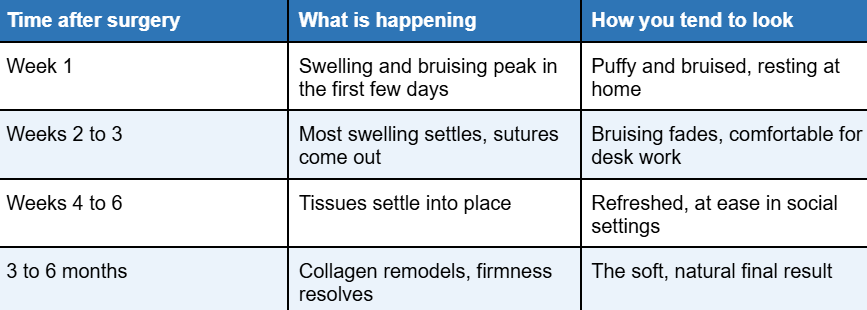
Scars follow their own gentle timeline. They look reddest early and then fade as they mature. One study found that overall scar appearance improved by roughly 40 percent between the first week and the third month after surgery. Many patients feel essentially normal within about six weeks, even though the deepest results keep refining for months. Patience is part of the process, and a good surgeon will set that expectation honestly before you ever book a date.
Think back to that reflection in the shop window. The aim of a good facelift is not to erase the face you saw. It is to soften what time has added and give you back the one you remember, so the next time you pause at a mirror you simply recognize yourself.
Choosing well matters more than any single technique. Look for a surgeon who focuses on the face, who is board-certified, who performs your surgery personally, and whose results look natural rather than overdone. You can see that approach in the deep plane work behind the Prendiville Signature Lift™, and a private consultation, in person or virtually, is the calm first step whenever you feel ready.
Dr. Prendiville and his team in Fort Myers, Florida have built their practice on one quiet promise: results that earn compliments, not questions, and still look unmistakably like you. When you would like to talk through what is bothering you and what is possible, you can reach the practice through the contact page or by phone at 239-437-3900. Thank you for reading, and take the next step only when the time feels right for you.
A well-performed facelift should not change how you smile or express yourself. The work targets the deeper support tissues, the jowls, the jawline, and the neck, while protecting the nerves and muscles that move your face. A careful, deep-tissue approach is designed to keep your expressions your own. Temporary or permanent changes in sensation, movement, or nerve function are recognized risks of the surgery, and they are worth talking through with Dr. Prendiville directly, including how he approaches them and what his own experience has been.
A facelift is long-lasting, and the deep plane technique tends to give the longest-lasting improvement. A facelift does not stop aging, and no procedure has a guaranteed lifespan. How long your result holds is partly subjective, and it depends on how you live and how happy you are with the change. Caring for your skin and protecting it from the sun help your result last.
There is no single right age. Dr. Prendiville notes that the ideal time is when you are in good health and you have aging changes that genuinely bother you. Most of his facelift patients are in their 50s, 60s, and 70s, but candidacy is about your face and your goals, not a number.
A mini facelift can give natural results for the right person, usually a younger patient with mild early sagging. The key is that it still lifts the deeper support layer rather than only tightening skin. For more advanced sagging, a full deep plane lift typically gives a more complete and lasting result.
Scars are placed in spots that naturally conceal them, following the hairline and the folds in front of and behind the ear. When incisions are closed without tension, they tend to heal as fine, faint lines that fade over the first several months. Scars are permanent, though, and how well they settle varies from person to person.
Thread lifts can offer a subtle improvement for very mild, early laxity, but the effect is temporary. They do not remove excess skin, and they cannot match the structural repositioning of a surgical facelift. For loose skin and descended tissue, surgery is the more durable option.
Cost varies widely by technique, surgeon, and region, so a single price is misleading. As general guidance, the American Society of Plastic Surgeons reports a national average surgeon fee of around $11,395, which does not include other surgical costs. Your own estimate is best reviewed during a private consultation, where the plan is built around your face.
In many cases, yes. A number of facelifts are performed safely under local anesthesia combined with light sedation, which lets you breathe on your own and avoid full general anesthesia. The right choice depends on your health and your plan, and your surgeon will review it with safety as the priority.
Candidacy is individual. It depends on your overall health and medical history, whether you use nicotine, your anatomy, how far the aging changes have progressed, your expectations, and whether you can safely get through surgery and recovery. Dr. Prendiville frames it simply by asking what bothers you, then reviewing your health history before anything else. The clearest way to know is to talk it through with him directly, covering his techniques, your own concerns about risks and complications, and his experience with the procedure, alongside a proper medical evaluation.
Disclaimer: This article is for educational purposes only and is not medical advice. Individual results vary and are not guaranteed. Consult a qualified, board-certified facial plastic surgeon to determine the treatment that is right for you.

