
Still, the numbers offer a useful reference point. Most facelifts happen later in life, and patients 56 and older make up the majority, according to an AAFPRS report.
That is exactly what this guide is here to help you sort out. Prendiville Facial Plastic Surgery in Fort Myers, Florida has focused only on the face for 25 years. Dr. Stephen Prendiville performs every procedure himself. Below, we walk through how aging changes decade by decade. We cover the signs that point to surgery over fillers, which procedure fits which stage, and how your age affects how long results last. We also look at when it is wiser to wait.
One thing is worth saying up front. The honest answer to "when" is personal. A good surgeon will tell you if it is too soon, just as readily as if it is time. The goal is never a different face. It is a refreshed, natural version of the one you already have.
Aging does not arrive all at once. It also does not call for the same fix at every stage. Your skin, the fat that shapes your face, and the support underneath all change at different rates. That is why the right procedure at 40 is rarely the right one at 65.
In your 30s, the changes are mostly on the surface. Fine lines and a little early volume loss are typical, but the deeper structure still holds. Searches for a "mini facelift in 30s" are common, yet at this age surgery is rarely needed. Very few facelift patients are in their 30s. A mini facelift at 35 makes sense for a small number of people, not most.
By the 40s, early structural change starts to show. The jawline can begin to blur, and the first hint of jowls may appear. Some people start to consider surgery here, and their skin still has good elasticity on its side. The 50s and 60s are the busiest stretch. This is often when the cheeks, jawline, and neck descend past what injectables can quietly manage. Many people are also fine candidates well into their 70s and beyond. Good health matters far more than the number.
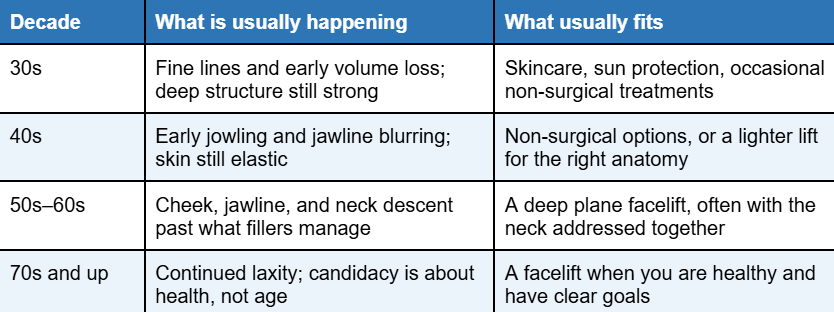
The pattern is steady, but your face is not a statistic. Where you actually fall on this map is the real question, and it is answered by looking at your features, not your age. That brings us to the signs that point toward surgery rather than another syringe.

The switch from fillers to surgery is about anatomy, not age. Fillers restore lost volume well. But once tissue has actually descended, adding more product only adds weight. As Dr. Prendiville often explains, both fillers and surgery have a real purpose. For something quick without downtime, fillers and Botox work well. For a lasting result that truly lifts, surgery does more. Here are the signs that usually mean it is time to consider that step.
When fat pads slide down and the support loosens, jowls form along the jaw. Filler can soften an early shadow. But it cannot lift true tissue descent back into place. If your jawline has lost its clean line, that is a structural change.
A sharp angle between the chin and neck is a sign of youth. As the platysma muscle and skin loosen, that angle softens, and vertical bands can appear. Botox may relax a band for a while. But loose skin and muscle in the neck usually need a surgical lift to truly improve.
As midface fat drifts down and inward, the youthful fullness flattens. The lower face then looks heavier. Early on, careful filler can help. Once the descent is real, only repositioning the deeper tissue restores the shape that volume alone cannot.
There is a point where chasing a lift with more filler starts to look puffy rather than refreshed. In a clinical review, people who eventually had a facelift had been getting injectables for years first. If your results fade faster, or you use more product for less effect, that is often the signal to talk about surgery.
It is completely normal to feel unsure about crossing from injectables to an operation. The reassuring part is simple. A careful surgeon will tell you honestly when fillers still have road left, and when a lift would serve you better.
Deborah, a Prendiville Facial Plastic Surgery patient who was nervous about a major decision, shared her experience:
"I was nervous about getting such a major surgical procedure, but after meeting Dr. Prendiville and his staff I felt so much more at ease and excited."
If you are seeing these signs and are not sure what they mean for you, you can request a private consultation, in person or virtually, to have them looked at by your surgeon. There is no pressure to schedule anything beyond a conversation. You can start that conversation here when you are ready.

Once surgery is on the table, the next question is which kind. The answer depends on how much laxity you have, where it sits, and how much recovery time you can take. The table below lays out the main options at a glance.
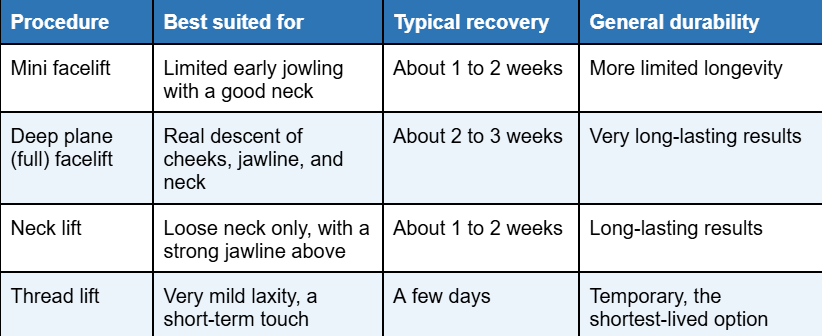
A mini facelift is a real option for the right anatomy, not a universal shortcut. It targets the lower third of the face and suits limited early jowling. A deep plane facelift goes further. It releases and repositions the deeper support layer, called the SMAS, along with the ligaments that hold the face. That is what produces a powerful yet natural lift, without pulling the skin tight.
This is the technique Dr. Prendiville has built his practice around with the Prendiville Signature Lift™, his deep plane facelift. His deep plane facelift also includes a deep neck lift. That means removing fat beneath the platysma muscle, slimming the deeper muscles under the chin, and reducing the salivary glands that sit under the jaw. This is not needed for every patient, but it is commonly done, and it greatly improves the neck result. When only the neck is involved and the jawline above is still strong, a neck lift on its own can be enough. Once jowls or midface descent join in, addressing the face and neck together holds up better. Thread lifts, by contrast, are temporary and rely on tension alone. A meta-analysis of more than 2,800 thread-lift patients found swelling and other side effects were common. So they are rarely a substitute for surgery when aging is structural. If you are weighing a thread lift against surgery, Dr. Prendiville can talk you through the trade-offs, your own concerns about side effects, and what he has seen in his practice.
Matching the procedure to your face is the whole point. The best choice is the one built around your features and your goals, which is also what makes the timing question so personal.
Age does more than decide whether you need surgery. It also shapes how long the result holds. Younger skin keeps more of its natural elasticity. So a lift done at 50 often lasts longer than the same lift done at 70, because the tissue has more spring to it.
That said, a facelift resets the clock. It does not stop it. Aging keeps going afterward, and many people consider a touch-up further down the road. A facelift does not stop aging, and no procedure has a guaranteed lifespan. The good news is that the head start holds. In a five-year study, most patients still looked younger than they had before surgery.
There is a balance here, though. Having a facelift very early, before there is much to correct, can mean more procedures over a lifetime, not fewer. The aim is not the youngest possible age. It is the right moment for your face. Because Dr. Prendiville performs every procedure himself, the plan and the result stay consistent from your first visit through recovery. And if you live out of the area, much of this can be reviewed through a virtual consultation, so distance does not force you to rush or wait.
Louise, a Prendiville Facial Plastic Surgery patient who wanted a lasting, natural result, shared her experience:
"I recently underwent a deep plane facelift with Dr. Prendiville, and from my very first consultation I felt completely confident and at ease."
If you are weighing the timing from another city, you do not have to do it all in person. You can request a private consultation, in person or virtually, to talk through where you are. Out-of-town patients can start with a virtual consultation and see what makes sense before traveling.
Sometimes the most honest answer is "not yet," and a careful surgeon will say so. Safety comes first. A few situations are worth sorting out before surgery, so your result holds and your recovery goes smoothly. The best way to know where you stand is to talk it through with Dr. Prendiville directly. He can walk you through his techniques, answer your specific concerns about risks and complications, and tell you about his own experience and complication history with the procedure.
None of this means the door is closed. It simply means a little timing now protects the result you want later. That is the whole reason the question is worth asking.
If you started reading caught between "too soon" and "too late," you are in very good company. The honest takeaway is that age is only one part of the picture. What really decides the timing is your anatomy, your health, and what you hope to see in the mirror.
The clearest next step is simply to look at your own face with someone who does this every day. You can read more about the deep plane facelift and the kind of natural result it produces, then talk it through when you feel ready.
Ana, a Prendiville Facial Plastic Surgery patient who valued a plan built around her, shared her experience:
"Certified and experienced doctor, expert on face and neck lifts, supported by an excellent staff, who outlines the best procedures for each case without forcing products or services."
At his Fort Myers practice, Dr. Prendiville focuses on one thing. That is helping you look like yourself again, only refreshed and rested, never operated on. When you would like a clear, personal answer to the timing question, you can request a private consultation, in person or virtually. Call 239-437-3900 or visit the contact page. Whenever you are ready, we would be glad to help.
There is no strict cutoff, but the youngest realistic candidates are usually in their late 40s, when real structural changes begin. Most people in their 30s do better with non-surgical care. The right answer comes from your anatomy, not a number.
Not on its own. A facelift lifts and repositions deeper tissue and removes loose skin, so it addresses sagging, jowls, and a heavy neck. Fine lines and sun damage are skin-surface issues, better handled with treatments like laser resurfacing. Many people combine the two for a complete refresh.
Only if your aging is limited to mild jowling and your neck is still in good shape. A mini facelift in your 30s or 40s suits a small group with early, focused changes. If the cheeks and neck are involved, a deep plane facelift gives a more complete and longer-lasting result. A consultation is the best way to know which fits.
Plan for roughly one to two weeks of social downtime after a mini facelift, and about two to three weeks after a full deep plane facelift. Most swelling and bruising settle within the first couple of weeks. Everyone heals at their own pace, so these are typical ranges rather than promises.
Often you do not need to. Most hyaluronic acid fillers can stay, but if they distort your natural shape, your surgeon may suggest dissolving them a few weeks before surgery. Longer-lasting fillers usually call for more lead time. Always tell your surgeon exactly what you have had and when.
Smoking meaningfully raises the risk of healing problems, because it narrows blood vessels and slows the skin's recovery. All smoking and nicotine products, including vaping, patches, and gum, should be stopped before and after surgery, on the schedule your surgeon sets. Being nicotine free, or quitting in time, makes you a safer and stronger candidate. Dr. Prendiville can talk you through how this applies to you and what he has seen in his own practice.
It should not. At this age the tissue is strong and elastic, which actually makes a natural, subtle result easier to achieve. The "over-operated" look usually comes from pulling skin tight, not from age. A deep plane technique repositions deeper tissue, so you look refreshed rather than done.
In most cases, no. Healthy patients in their 70s and 80s have facelifts routinely, because candidacy is about your health, not your birth year. A thorough review of your health history comes first. The best way to know is a private consultation with a single, experienced surgeon who will be honest about what is right for you.
Disclaimer: This article is for educational purposes only and is not medical advice. Individual results vary and are not guaranteed. Consult a qualified, board-certified facial plastic surgeon to determine the treatment that is right for you.

